Using AI Tools with HYPR AgentPass
Who this is for: employees whose AI tools run through HYPR AgentPass™. That includes developers who use coding agents such as Claude Code on a work computer, and people who chat with agents in the Agent Portal or in Slack. You need no console role. If you look after an agent, you also approve its requests in the HYPR app on your phone.
Purpose
This guide shows you how to keep using your AI tools now that they run through AgentPass. When you finish:
- Each place you use AI is set up: your browser, Slack, your work computer and, if you approve requests, your phone.
- You know what each AgentPass notice means, and what to do next.
- You know who to ask for help.
You need no technical knowledge, except for the steps on a work computer, which your IT team usually does for you.
Architecture
An AI tool is software you ask for help in plain words, such as Microsoft 365 Copilot. An agent is an AI tool that also takes actions for you, such as looking up a record or sending a message.
AgentPass sits between these tools and the services and company systems they reach. Requests pass through it on the way. As they pass, AgentPass does these things:
- Checks each request, and sometimes the answer, against your organization's rules
- Holds certain actions until a person approves them
- Keeps a record of what was asked and what happened
Your organization uses it so that people can work with AI while customer data and company systems stay protected. The tools you use through it act as you, with your own access.
What Changes for You
Most of the time, nothing looks different. You ask, and the answer comes back. Now and then, AgentPass stops a request, holds it for approval, or reports that an agent is turned off, and tells you what to do next.
| How you use AI | What changes |
|---|---|
| Chatting with Copilot or your organization's own agents | You use them in the Agent Portal, a web page your administrator gives you. See Chat in the Agent Portal |
| Chatting with an agent in Slack | You ask the same way. Some replies are now notices from AgentPass. See Use an Agent in Slack |
| AI tools on your work computer, such as Claude Code | Your organization may set them up to go through AgentPass for you. See AI Tools on Your Work Computer |
| Agents you are responsible for | You may be asked to approve their requests on your phone. See Approve Requests on Your Phone |
Prerequisites
Have these ready for the places you use AI:
| Where you use AI | What you need | Setup |
|---|---|---|
| Your web browser | Your work Microsoft account, and the Agent Portal link your administrator sends you | None |
| Slack | Your Slack account | None |
| AI tools on your work computer (Mac or Windows) | The tool's own sign-in. To install Endpoint Guard yourself, the details your IT team gives you | Usually done for you |
| The HYPR app on your phone | Your work phone, only if you approve requests | Once |
Procedure
Each task stands on its own. Do the ones for the places you use AI.
Chat in the Agent Portal
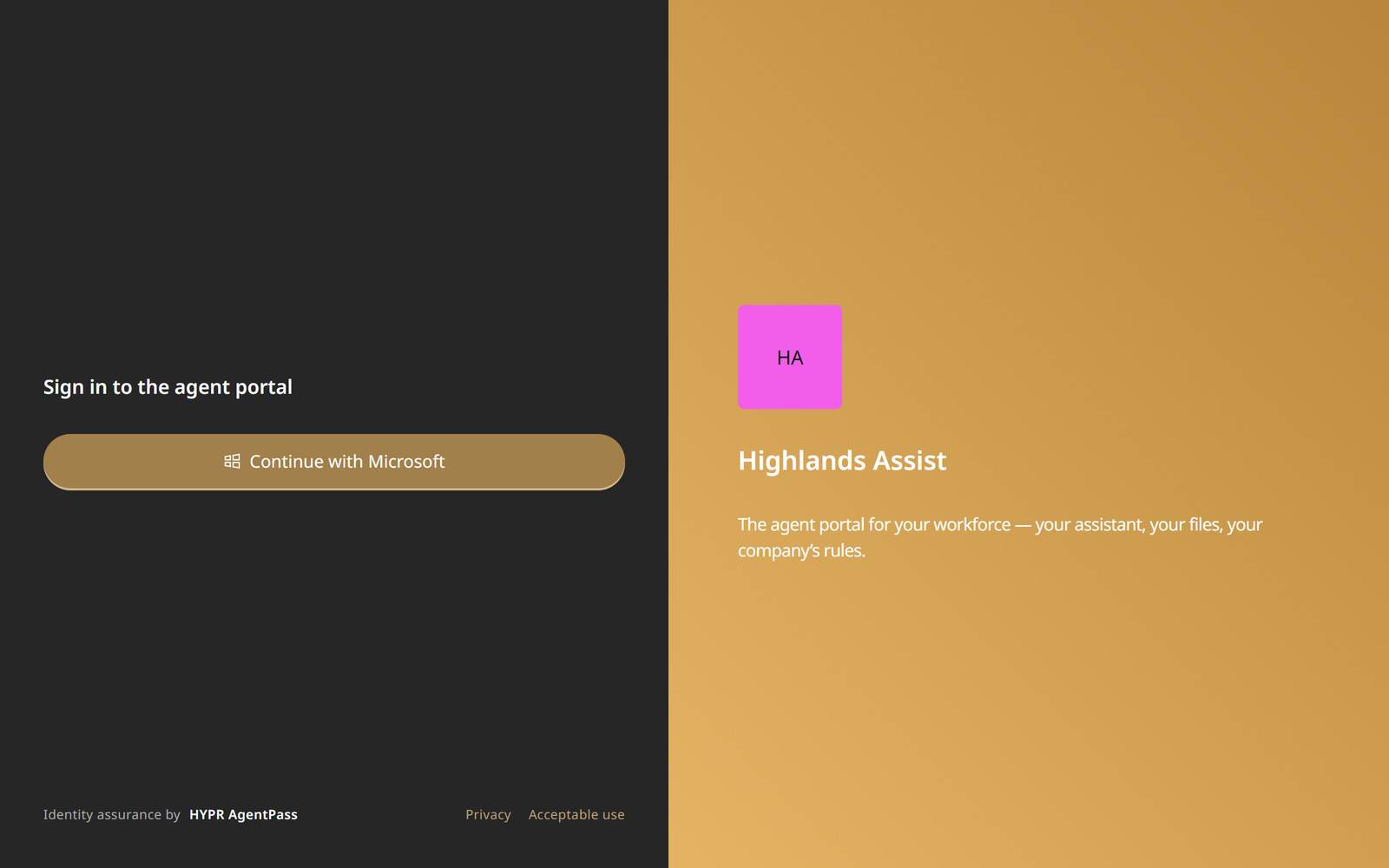
The Agent Portal is a web page where you chat with Microsoft 365 Copilot and your organization's own agents. Your organization may give it its own name, colors and logo. In these examples, the portal is called Highlands Assist.
Sign In
-
Open the Agent Portal link your administrator sent you. The sign-in page opens.
-
Click Continue with Microsoft.
-
Sign in with your Microsoft work account in the window that opens. The portal greets you by name, with a new Copilot chat ready.
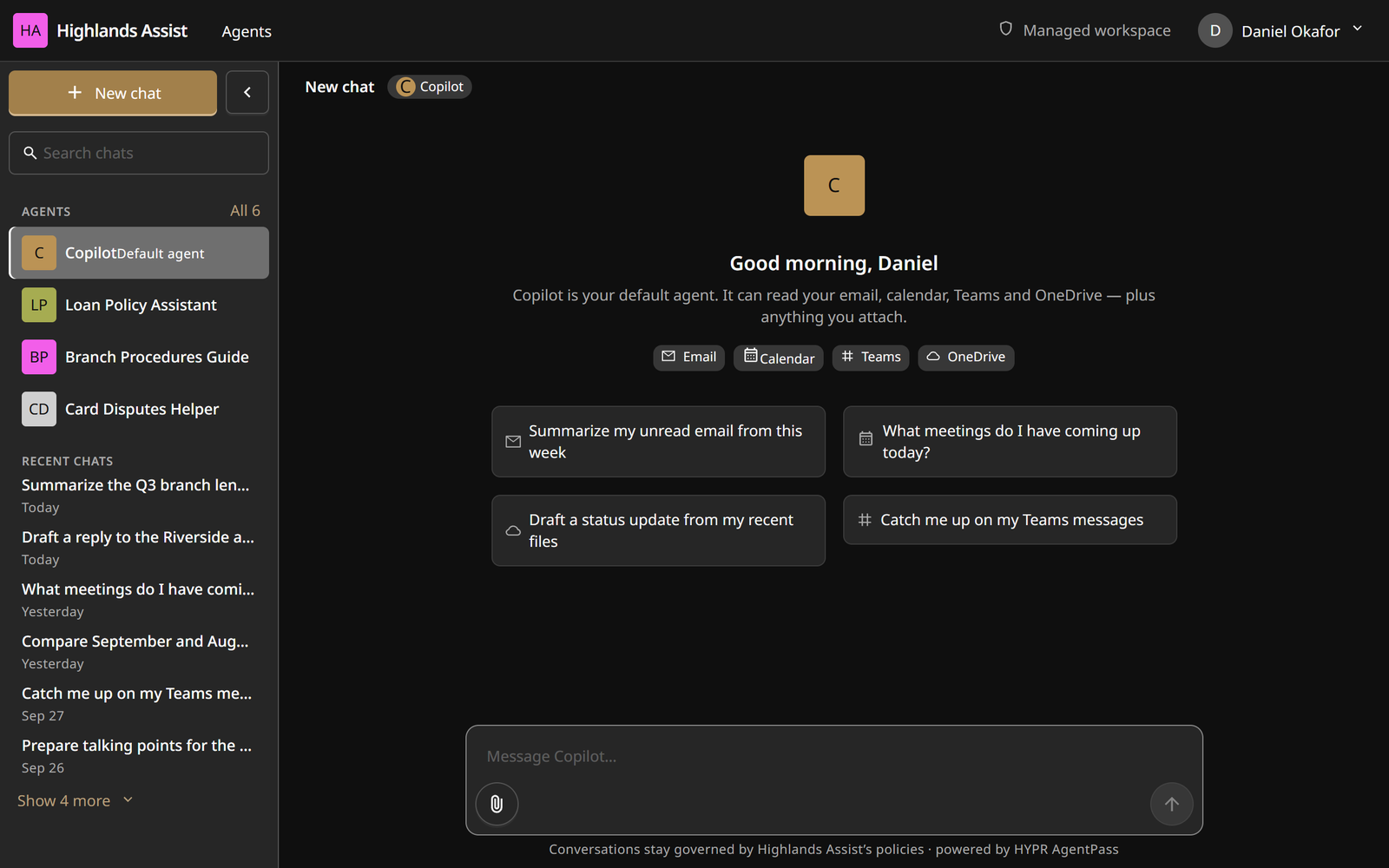
The portal keeps you signed in while the page stays open. If you reload or close the page, click Continue with Microsoft again. Microsoft may sign you straight back in without asking for your password.
Ask Copilot a Question
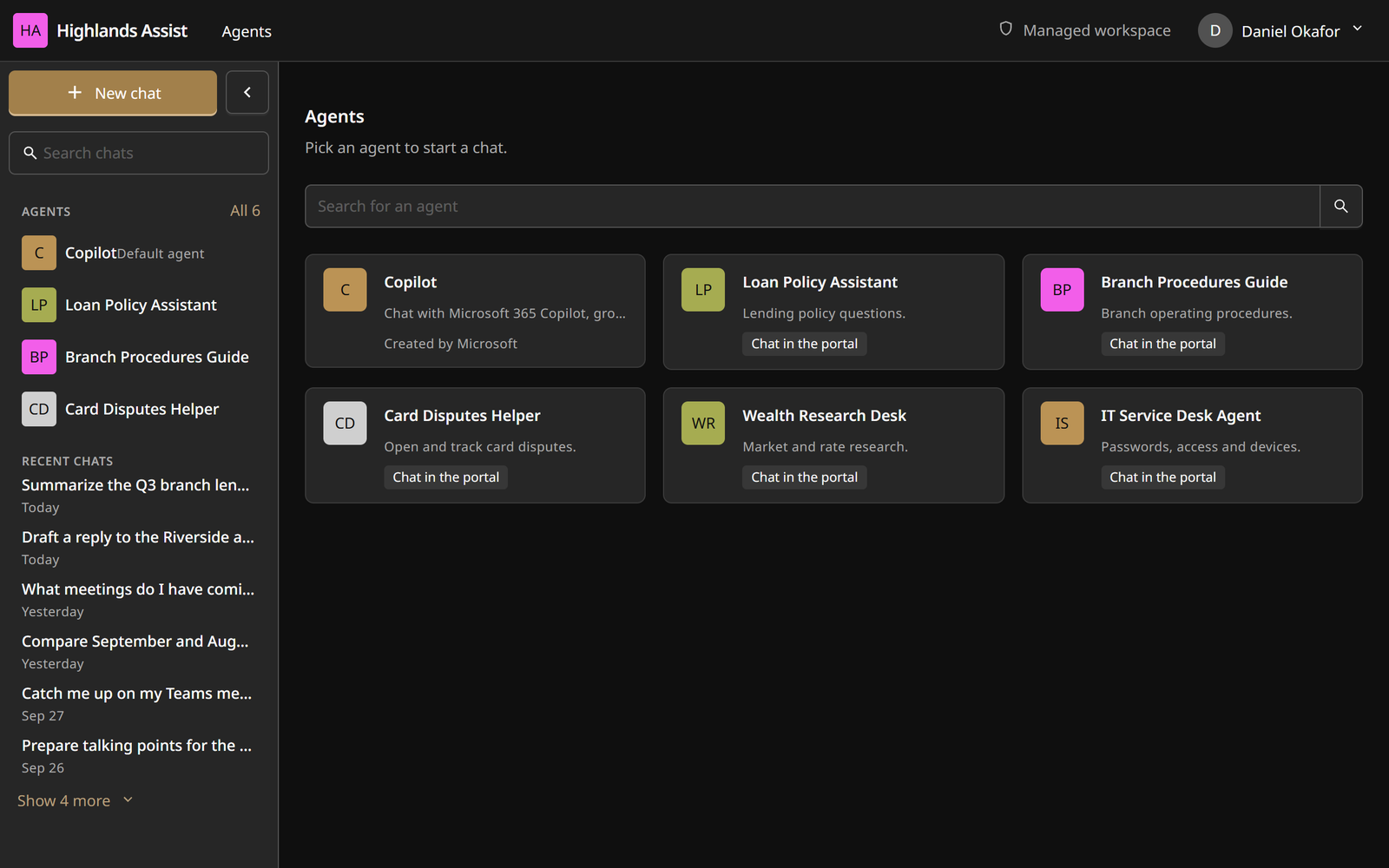
The sidebar lists your agents under AGENTS, with Copilot first, and your earlier Copilot chats under RECENT CHATS.
- In the message box, type your question, or click a suggested prompt.
- Press Enter to send. The answer appears as Copilot writes it.
For a new line in your message, press Shift+Enter. To start a fresh conversation, click New chat. To reopen an earlier Copilot chat, click it under RECENT CHATS. For an older chat, type a few words in Search chats.
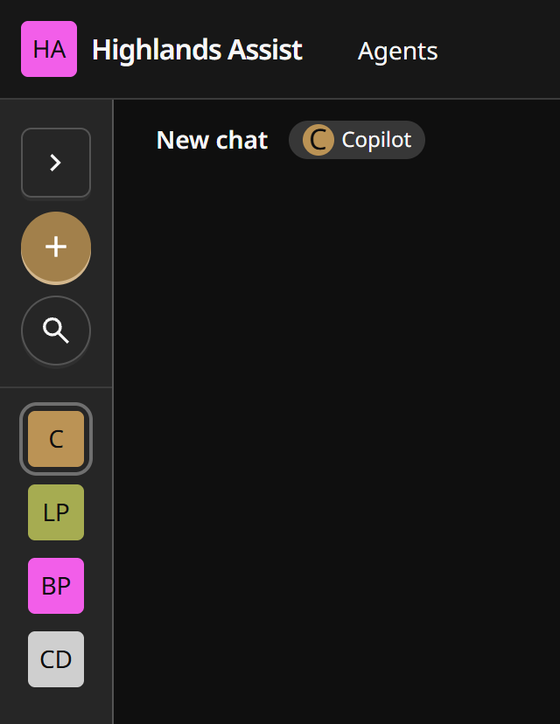
In a narrow window, the sidebar shows each agent's initials only. Click the arrow at the head of the sidebar to expand it.
Managed workspace in the header, and the line under the message box, show that the conversation is covered by your organization's rules.
Chat with One of Your Organization's Agents
-
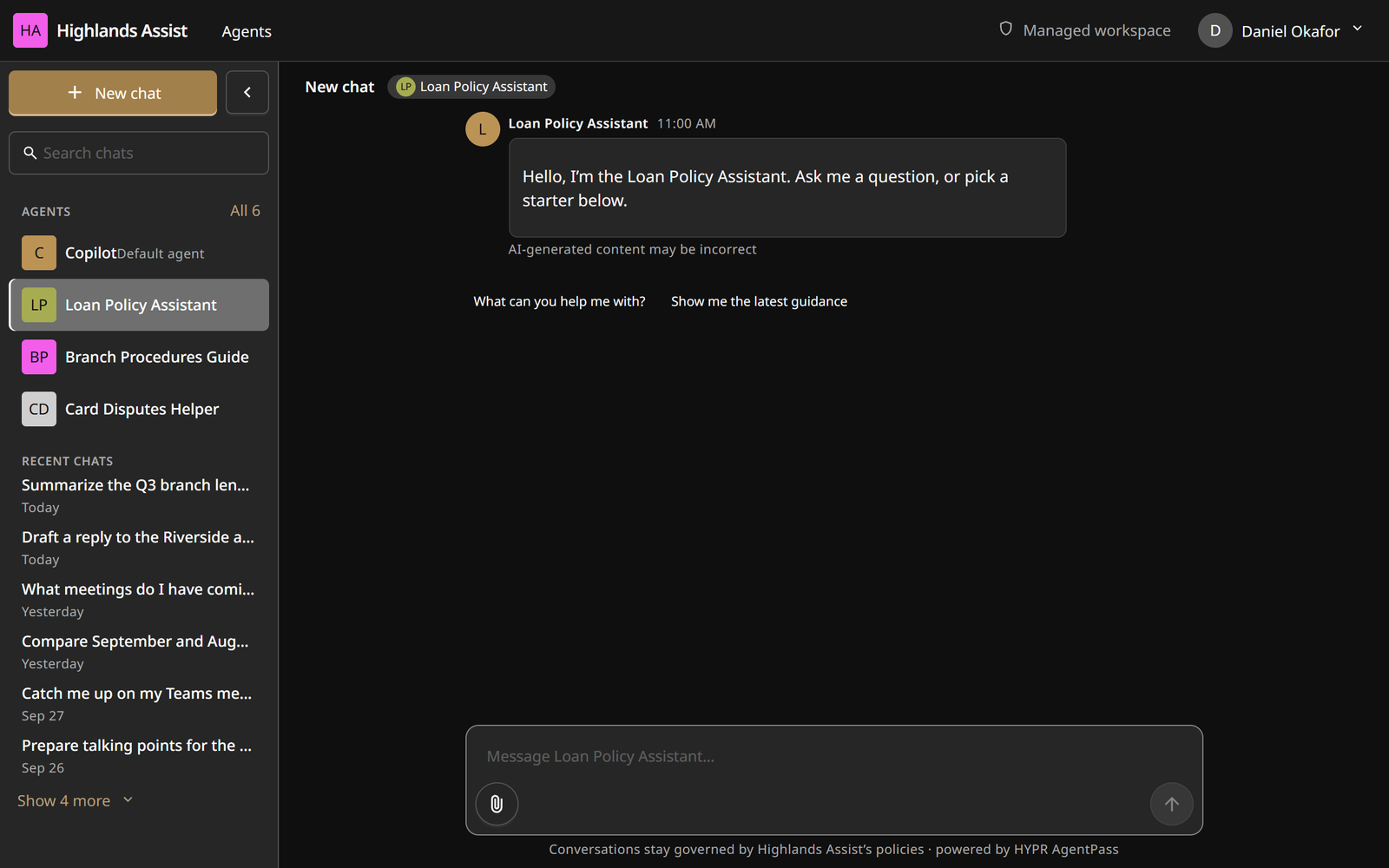
In the sidebar, under AGENTS, click the agent you want. The agent greets you, and offers questions to start with.
-
If the agent you want isn't in the sidebar, click Agents in the page header, and click the agent there.
-
Type your question, and press Enter. The answer appears in the conversation.
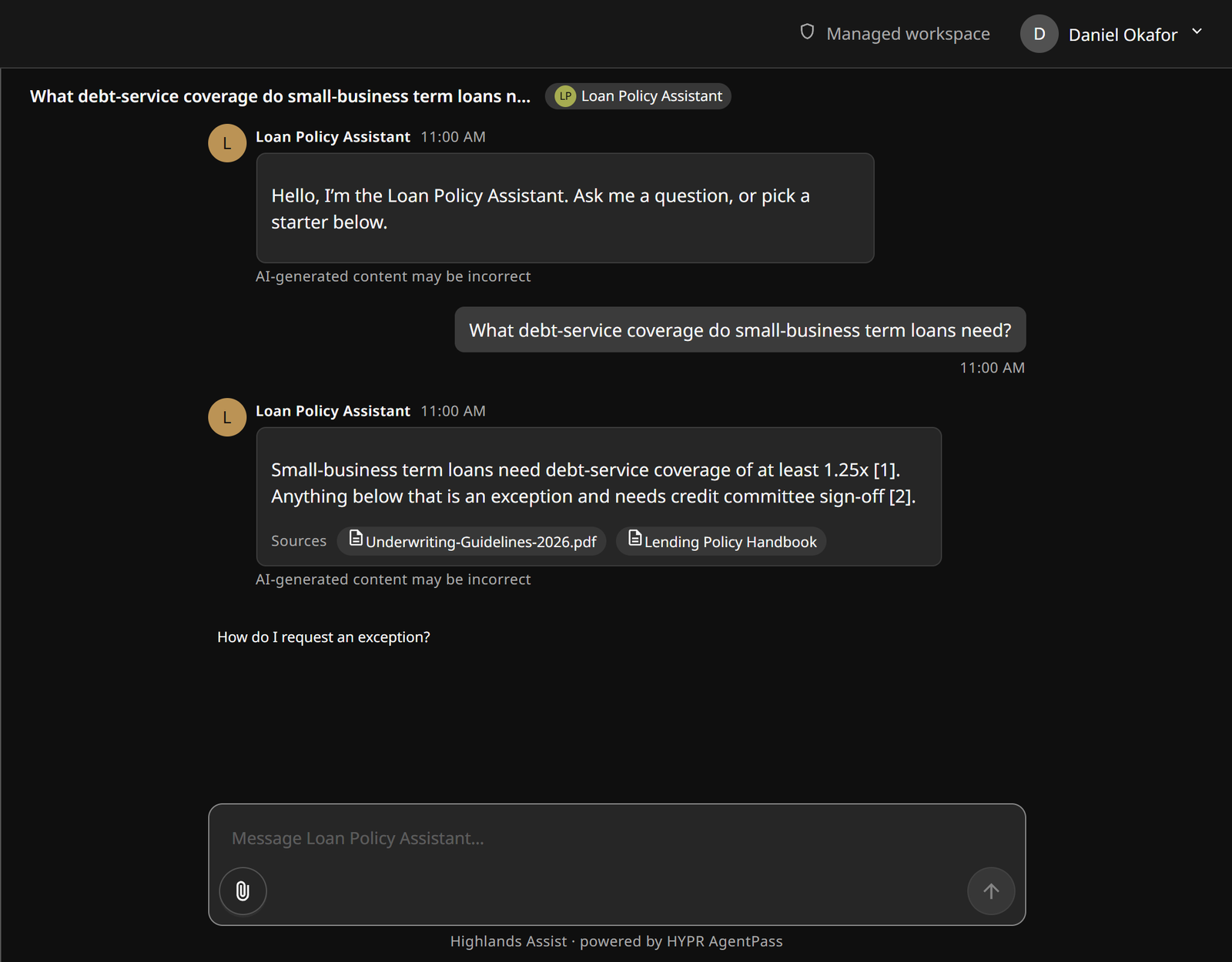
Numbers such as [1] point to the documents in the Sources row under the answer. Hover over a source to see its number. Click it to open the document, if it has a link.
Everyone in your organization sees the same list of agents. If one you need is missing, ask your administrator to add it.
Answers in the portal are written by AI, and each one carries the reminder AI-generated content may be incorrect. Check anything important before you act on it.
Attach a File
-
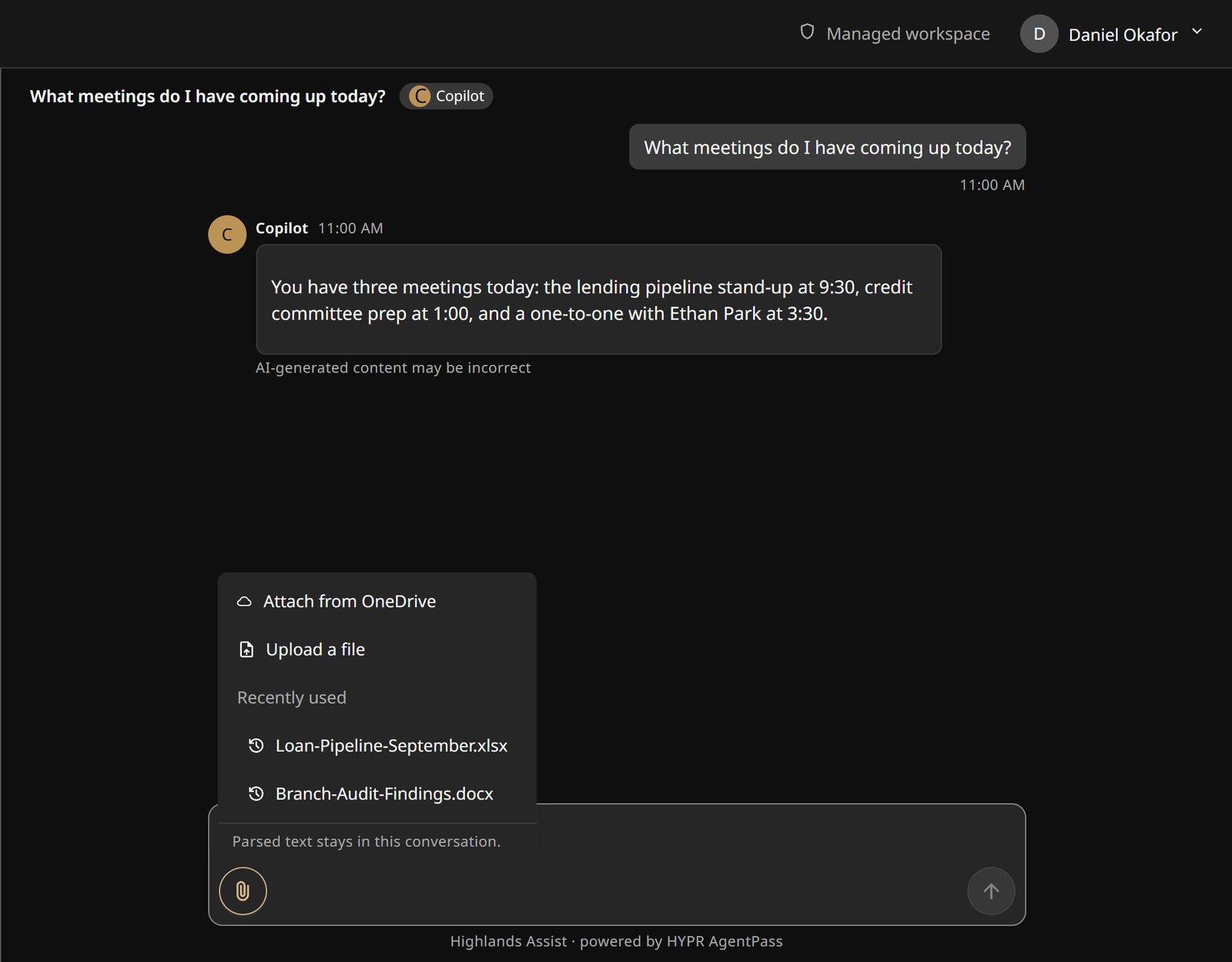
In the message box, click the paperclip.
-
Click Upload a file, and choose a file on your computer. In a Copilot chat, you can click Attach from OneDrive instead. Your organization's own agents offer Upload a file only.
-
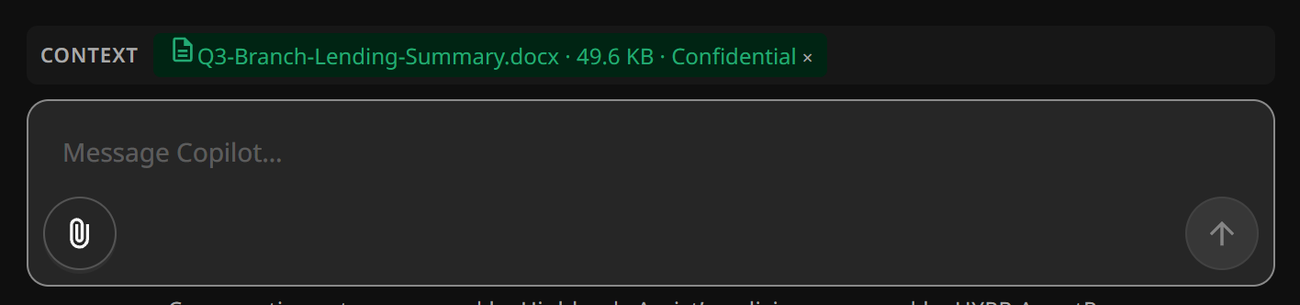
Wait for the file's label to appear above the message box. It shows the file's size and, for Office files, its sensitivity label.
-
Type your question about the file, and press Enter.
Your organization's rules apply to the file, the same as to your message. A file must be 20 MB or smaller, in a common document format. For an older .doc or .ppt file, a macro-enabled Office file or a PowerPoint slideshow, save a copy as .docx or .pptx, and upload that. For the formats accepted, see Upload a File from Your Computer.
Sign Out
-
Click your name in the page header.
-
Click Sign out.
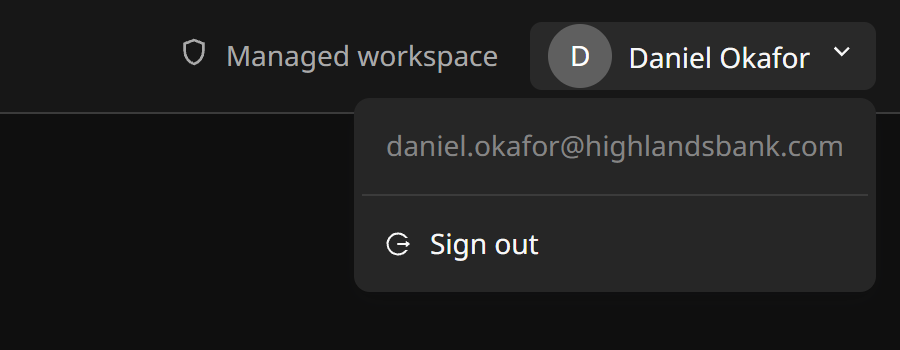
This ends only your portal session. Your other Microsoft 365 apps stay signed in. Sign out when you finish on a shared computer.
For everything else the portal can do, see Chatting in the Agent Portal.
Use an Agent in Slack
Your organization may connect an agent to Slack. There's nothing to set up. The agent recognizes you from your Slack account, and each request runs as you, under the same rules as the rest of your AI use.
- In Slack, open a direct message with the agent's app, or mention the app in a channel.
- Type your question, and send it. The agent answers in the thread of your message.
- To follow up, reply in the same thread. In a channel, mention the app again in your reply.
When the agent needs an approval from you, it asks in the thread, and the request goes to the HYPR app on your phone. See Approve Requests on Your Phone. When the agent can't answer, its reply tells you why. See Notices at a Glance.
AI Tools on Your Work Computer
Your organization may install HYPR Endpoint Guard on your work computer. On a Mac, Endpoint Guard is an app called AgentPass, with an icon in the menu bar. On Windows, it's a background service with no window. Either way, it can send your AI tools' requests through AgentPass, report which AI tools run on the computer, and block AI services your organization doesn't allow. On a Mac, it sends the requests of Claude Code, Claude Desktop and Codex through AgentPass, and applies your organization's rules to Cursor. You use the tools as usual.
Endpoint Guard reports which AI tools are running, on which computer and under which signed-in account. It doesn't read your files.
Your IT team usually installs it for you. Follow the installation steps for your computer only if they ask you to.
Install AgentPass on a Mac
You need macOS 13 or later, and an administrator's name and password for the Mac. Your IT team gives you the AgentPass installer package, your organization's gateway address and an enrollment token. If they installed AgentPass for you, go to Approve the AgentPass Components.
- Double-click the installer package. It opens at the Configuration step.
- In AgentPass server, enter the gateway address. It starts with
https://. - In Enrollment token, paste the token. It starts with
ssf_. - Select I agree to the End User License Agreement, and click Continue.
- Click Install, and enter an administrator's name and password when macOS asks.
When the installation finishes, AgentPass opens, and so does the AgentPass Setup window.
Treat the enrollment token like a password. Don't share it, and don't use it on another computer.
Approve the AgentPass Components
-
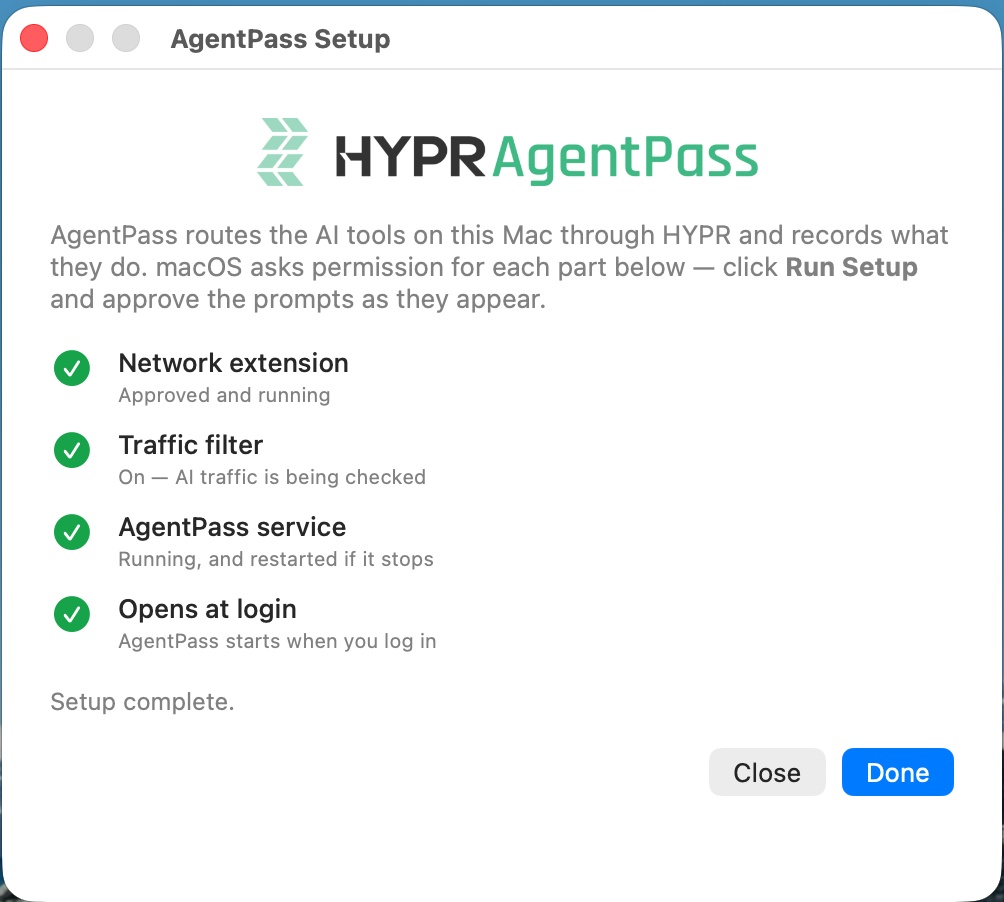
If the AgentPass Setup window isn't open, click the AgentPass icon in the menu bar, and click Run Setup….
-
Click Run Setup.
-
Approve each macOS prompt as it appears: allow the system extension, then allow AgentPass to filter network content. Each item in the window shows a check mark when it's ready.
-
Click Done.
To check it worked, look for the AgentPass icon in the menu bar. Its menu offers About AgentPass, Run Setup…, Share Diagnostics… and Share Logs….

Quitting the AgentPass menu bar app doesn't turn AgentPass off. It keeps working in the background.
Install Endpoint Guard on Windows
Your IT team usually installs Endpoint Guard for you. If they did, there's nothing for you to enter. Restart your AI tools, and carry on working.
If they ask you to install it yourself, they give you three things: the installer, your organization's gateway address and an enrollment token. The token lets your computer join your organization's AgentPass. You don't sign in with it, but keep it private, as on a Mac. You also need Windows 11 version 24H2 or later, 64-bit, and administrator rights on the computer.
You can sign in to Claude Code and Codex before or after the installation.
- Double-click the installer, and click Yes when Windows asks whether to allow it to make changes.
- In AgentPass server, enter the gateway address.
- In Enrollment token, paste the token. It starts with
ssf_. - Leave Set up Claude Code to use AgentPass right away (recommended) selected.
- Leave the Claude Desktop option selected too, even if Claude Desktop isn't installed yet. Claude Desktop then uses your Claude Code sign-in, so stay signed in to Claude Code. Your IT team delivers its updates.
- Select I agree to the End User License Agreement, and click Install.
Endpoint Guard runs in the background as a Windows service. Your IT team can see in the AgentPass console that your computer has joined. Restart Claude Desktop after the installation.
If your IT team asks you to remove Endpoint Guard, open Settings > Apps, find HYPR AgentPass Endpoint Guard, and uninstall it.
Route Claude Code Through AgentPass
Endpoint Guard sets this up for you. On Windows, restart Claude Code after the installation. If Claude Code's option was cleared during the installation, sign out of Windows and back in first.
Set the address yourself only if your IT team asks you to. They give you the gateway address.
-
Set the
ANTHROPIC_BASE_URLenvironment variable to the gateway address.On Windows, in PowerShell:
setx ANTHROPIC_BASE_URL "https://<your-gateway-address>"On a Mac, in Terminal:
export ANTHROPIC_BASE_URL="https://<your-gateway-address>" -
Restart Claude Code, so it picks up the new address. On Windows, open a new PowerShell window first.
Keep signing in to Claude Code as you do now, with your Claude account or an Anthropic API key. The first request from Claude Code may need its supervisor's approval. Claude Code either waits for it, or tells you it doesn't have access yet. In that case, send your message again once it's approved.
Sign In to Your AI Tools
Sign in to Claude Code or Codex once, the usual way. In a terminal, run claude for Claude Code, or codex login for Codex. AgentPass starts checking the tool's requests after you sign in.
Everyday Use
- Use the tool as you normally do.
- Restart the tool when your administrator says its setup has changed. A running tool keeps its old settings until it restarts.
When a rule stops or holds a request, the notice appears in the tool's own window, as part of its reply. On a Mac, AgentPass also shows its own prompts from the menu bar icon, described in the next section. On Windows, Endpoint Guard shows no prompts of its own.
What You See on a Mac
AgentPass on a Mac tells you when a tool needs a restart, or when your organization doesn't allow a connection. Each prompt says what happened, then what to do.
| Prompt | What it means | What to do |
|---|---|---|
| AI Agent Blocked, with Direct access to AI agents is not allowed per company policy. | A tool tried to reach its AI service directly instead of through the gateway, usually because it was already running when your organization's settings arrived | Click Quit and the tool's name, then start it again. If the prompt says the terminal was also started before the settings, quit your terminal app, reopen it, and then start the tool |
| AI Agent Blocked, with Your organisation wants a tool to connect through its gateway. | The tool isn't one AgentPass sets up for you | Set it up as your administrator describes, then start it again |
| A tool is now routed through the HYPR gateway, or is configured for the HYPR gateway | Your organization's settings reached a tool that's running | Click Restart and the tool's name, or Later to restart it yourself |
| A tool is still running | The tool didn't quit when asked, usually because it's waiting for you to save something | Quit the tool yourself, then open it again |
| A website is blocked by your organisation | Your organization doesn't allow that AI service | Use the alternative the prompt names, if there is one |
| This Mac is no longer managed by HYPR AgentPass | Your organization removed the computer from AgentPass | Ask your IT team |
Click Dismiss to close an AI Agent Blocked prompt. AgentPass waits a minute before it shows the prompt again for the same tool.
Approve Requests on Your Phone
You need this task only if you look after an agent, or your organization asks you to approve your own requests, such as the approvals a Slack agent asks for. Approvals reach you in the HYPR app, and you confirm each one with a passkey. A passkey is a sign-in key stored on your phone, and unlocked with your face, fingerprint or phone PIN. There is no password to type or steal.
Turn On AgentPass in the HYPR App
Install the HYPR app the way your administrator tells you. AgentPass needs iOS 17 or later, or Android 14 or later.
On iPhone:
-
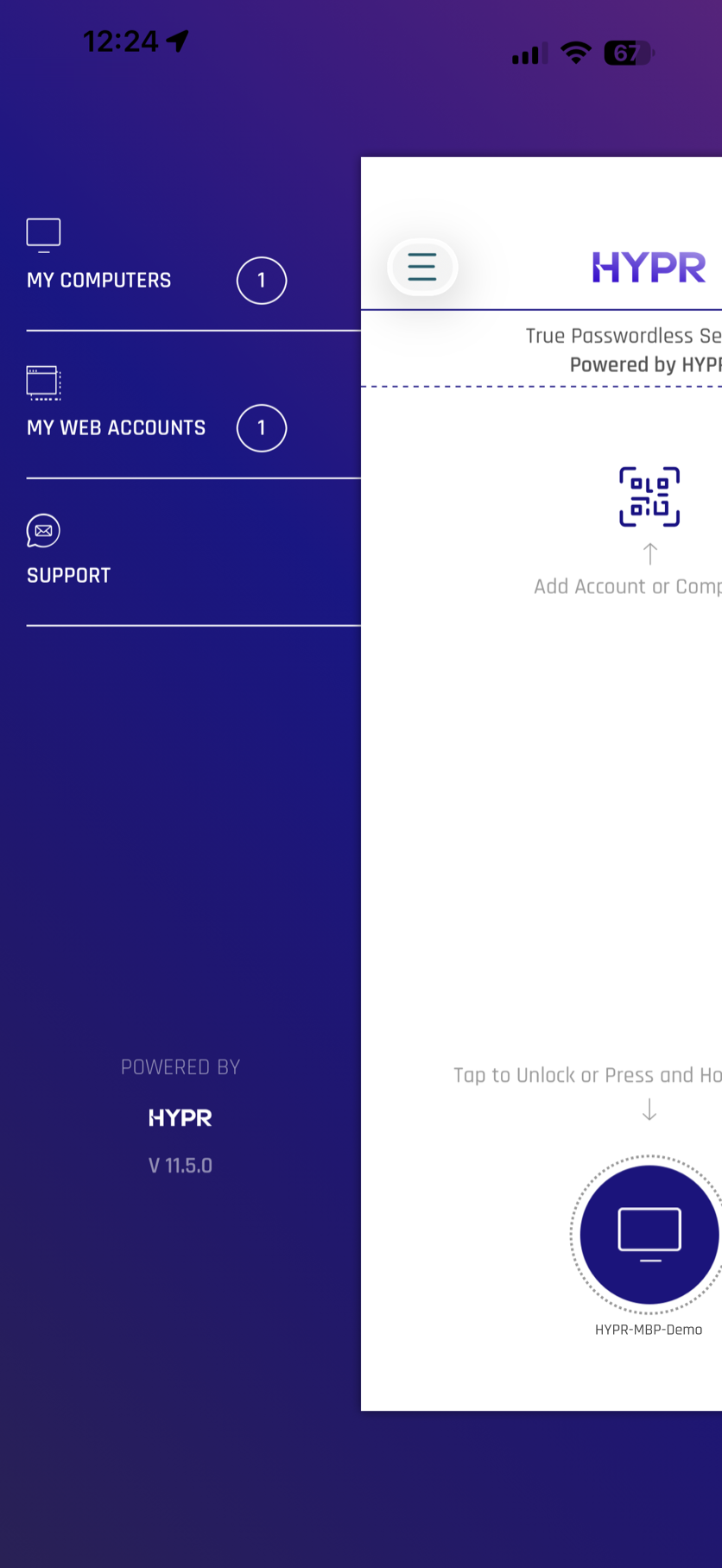
Open the HYPR app.
-
Double-tap the version number. Before you register the phone, it's on the welcome screen. Afterward, open the side menu, where it's at the bottom.
-
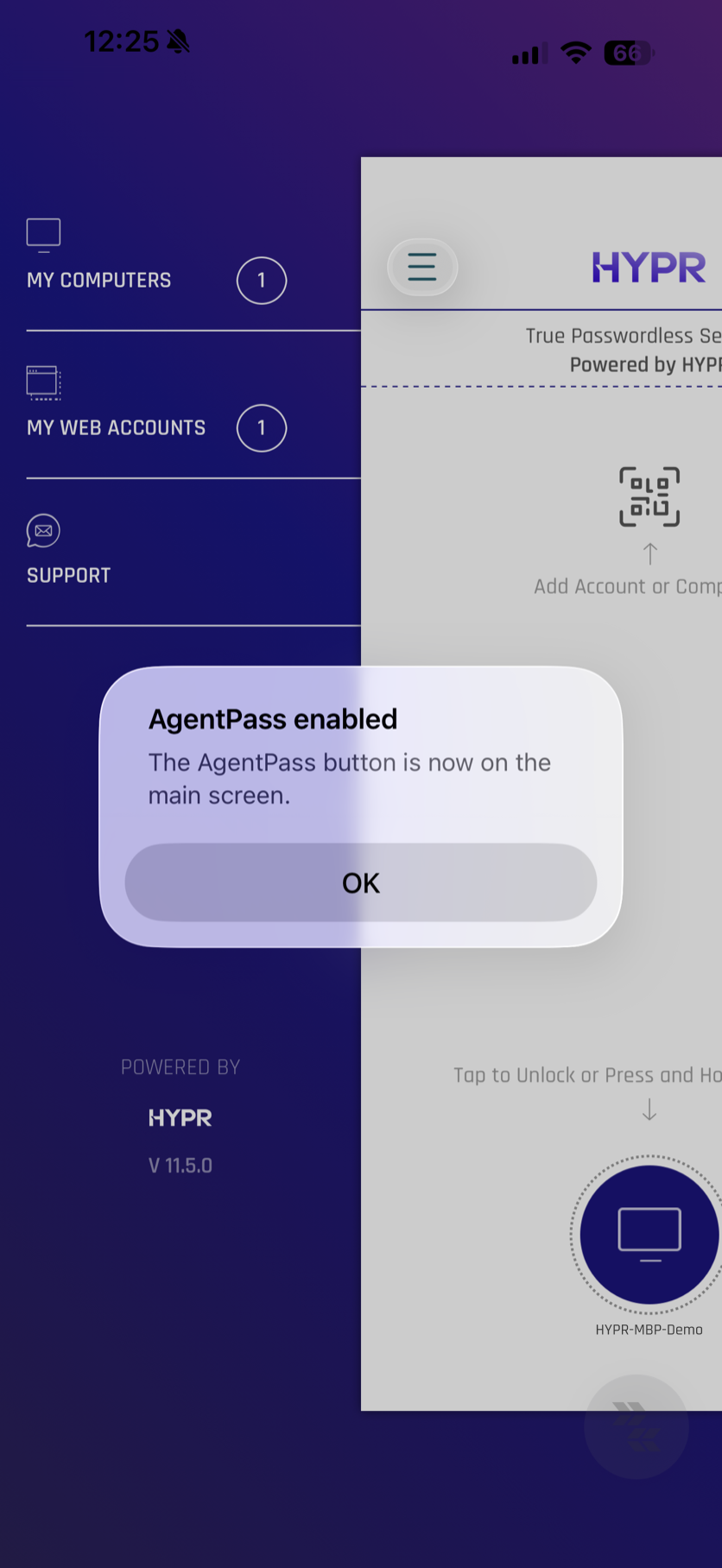
Tap OK in the AgentPass enabled alert. Close the side menu, if you opened it. A round AgentPass button appears on the main screen.
On Android:
-
In the HYPR app, double-tap the HYPR logo. It's on the welcome screen, or at the bottom of the side menu.
-
In Try the new UI?, tap Continue.
-
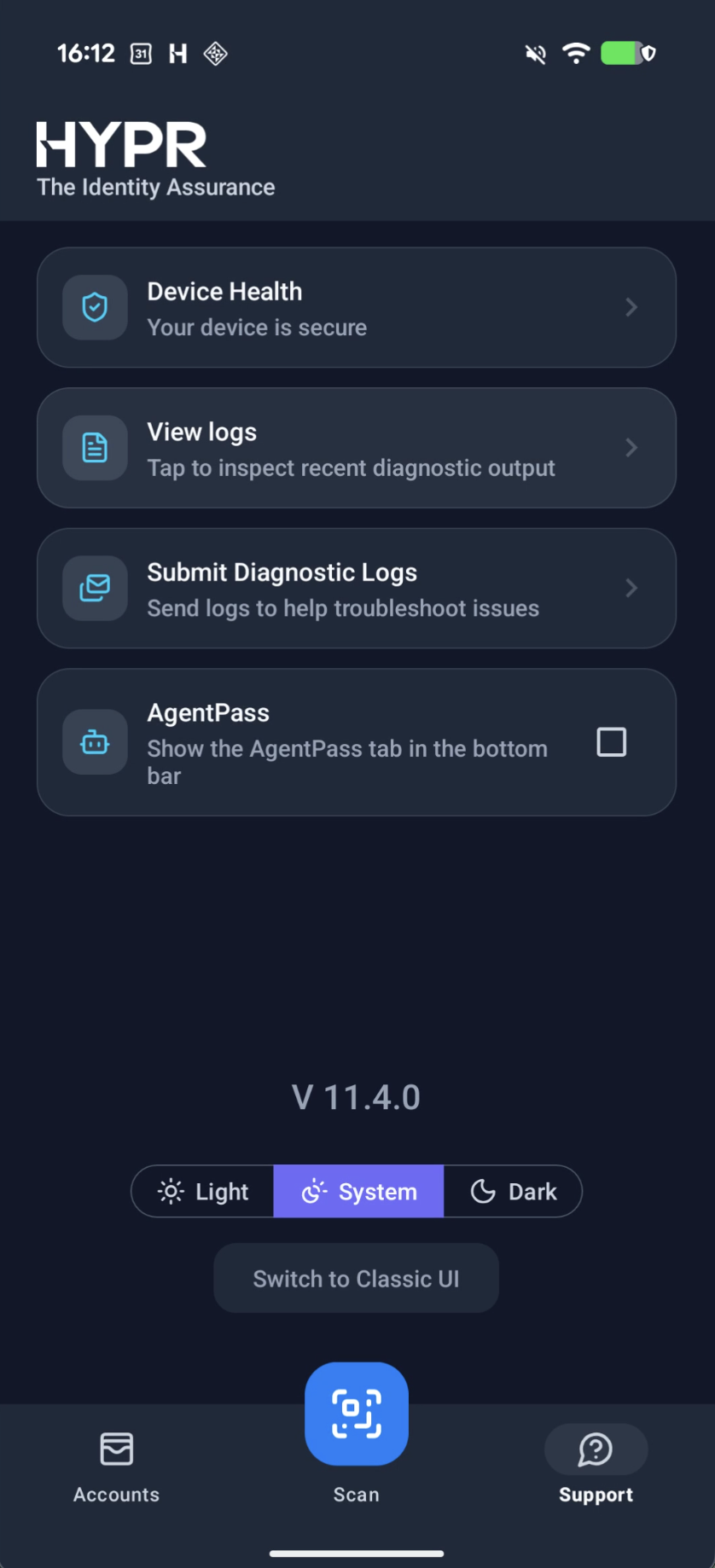
On the Support tab, select the AgentPass checkbox.
-
If Enable HYPR Credential Provider opens, tap Open Settings.
-
Tap Preferred service.
-
Choose HYPR Credential Provider.
-
Tap Change.
-
Go back to the HYPR app. The AgentPass tab is now the first tab.
For more detail, see Getting the HYPR App on iOS or Getting the HYPR App on Android.
Set Up Your Approval Passkey
-
On your computer, open the AgentPass console at the address your administrator gives you, and sign in.
-
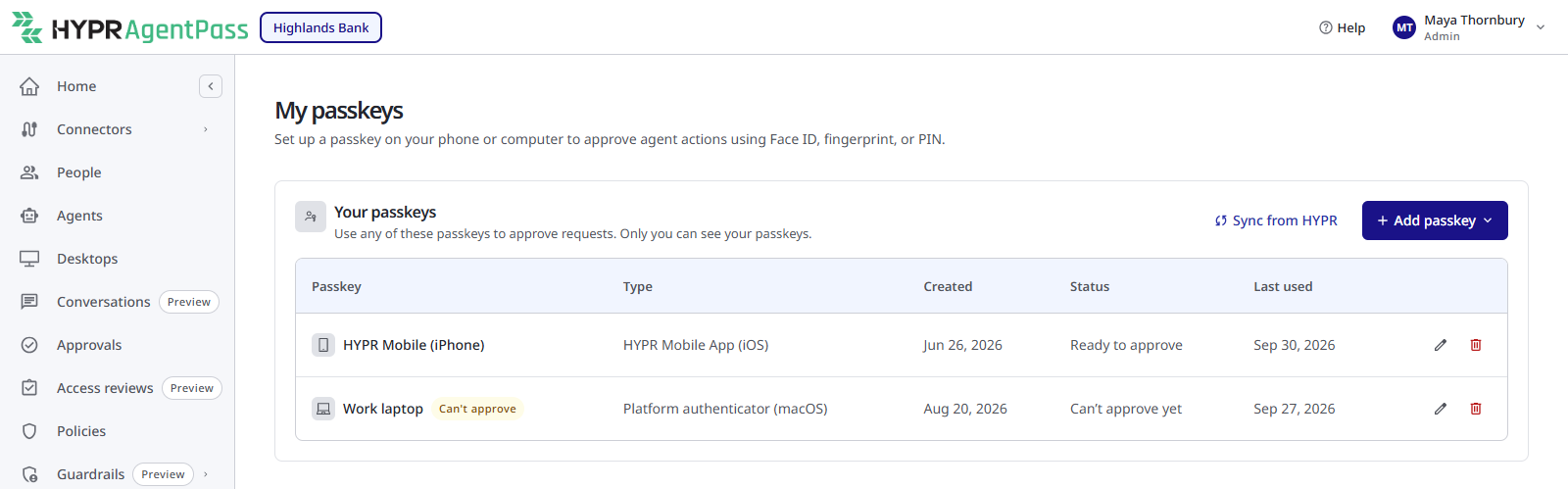
Click your name at the top right, then My passkeys.
-
Click Add passkey, then On my phone.
-
In Label, enter a name you'll recognize, such as "work phone".
-
Click Enroll. A QR code appears.
-
Scan the QR code with the HYPR app, and complete the prompt on your phone. Your phone appears under Your passkeys.
Then connect the app:
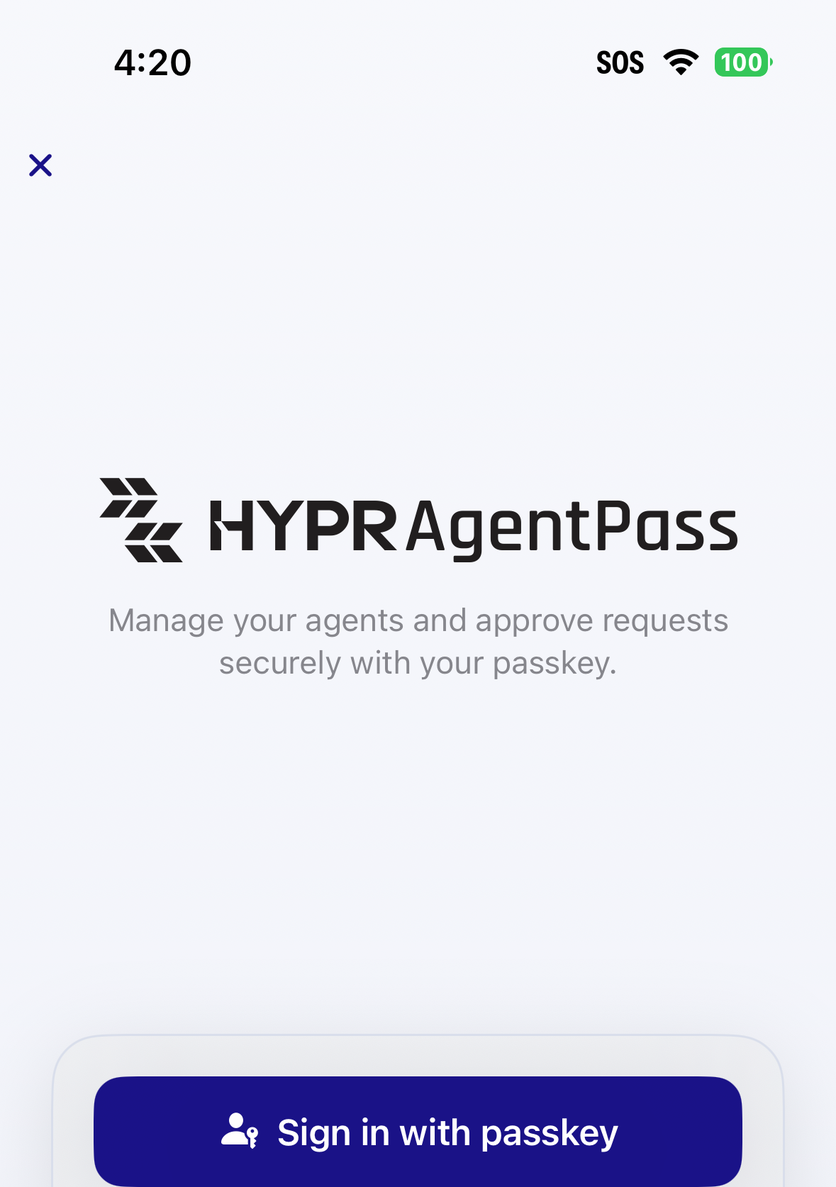
- iPhone: tap the AgentPass button, tap Sign in, and approve the prompt on your phone.
- Android: open the AgentPass tab, and tap Connect to AI Gateway.
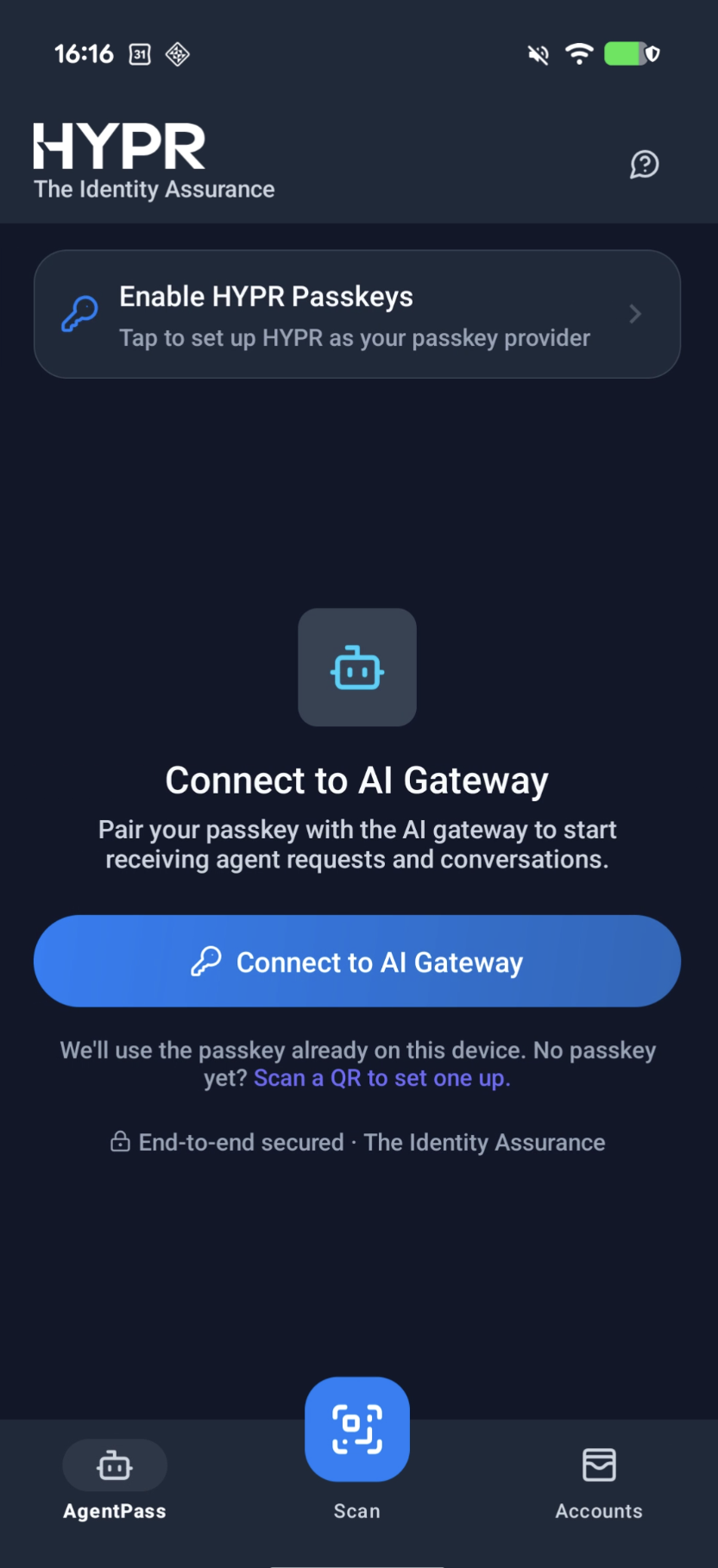
AgentPass opens with your agents, and any requests waiting for you. See Setting Up Your Approval Passkey.
Answer a Request
- Tap the notification on your phone. The request opens in the HYPR app. On iPhone, it's under Needs you.
- Read which agent is asking, and what it wants to do.
- If you recognize the request, tap Approve. If the request asks you to sign in to a service, sign in. On iPhone, tap Authenticate.
- Confirm with your face, fingerprint or PIN.
If you don't recognize the request, or it isn't what you expected, tap Deny instead. On Android, confirm once more.
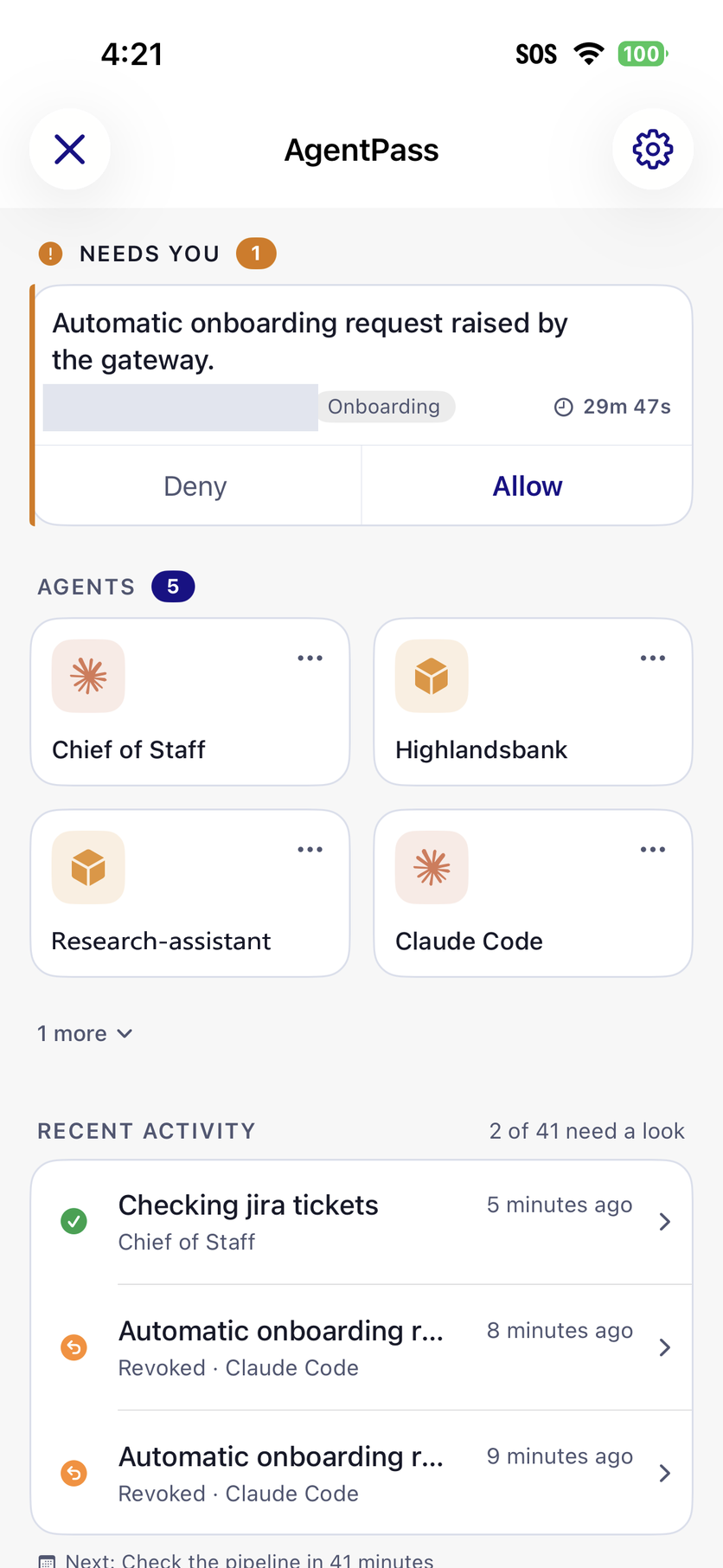
Your approval is signed with your passkey, so the record shows the decision was yours. If a request looks unfamiliar, deny it, and tell your administrator.
A request you don't answer in time expires, and the action doesn't go ahead. When you approve a request from Slack, ask the agent again in the same thread.
If one of your agents does something you didn't intend, you can turn it off from the app straight away. See Turning an Agent Off.
Respond When AgentPass Steps In
When a rule stops or holds a request, the tool tells you. Nothing went wrong on your side.
When a Message Is Blocked
Your organization's rules can stop a message or a file before it reaches an agent. Nothing was sent.
- In the Agent Portal, a short notice appears where the agent's reply would be. In a chat with one of your organization's agents, the notice gives the reason your organization wrote for that rule. When a rule stops a file, its label above the message box reads Blocked, and the file isn't sent. Hover over the label to see the reason.
- In Slack, the agent replies in the thread with a ⛔ notice. It gives the rule's reason, or reads A policy blocked this request.
- In an AI tool on your computer, the tool shows a reply that starts with Blocked by policy, followed by the rule's name and its reason. The reply says your organization's gateway inserted it, so it wasn't written by the AI. Your request never reached the AI. Sending it again is blocked again, but you can carry on in the same conversation with a different request. When a rule stops a step the AI was about to take, such as running a command, the notice starts with ⛔, and that step never ran. When a rule stops the AI's answer, the reply says the answer was withheld.
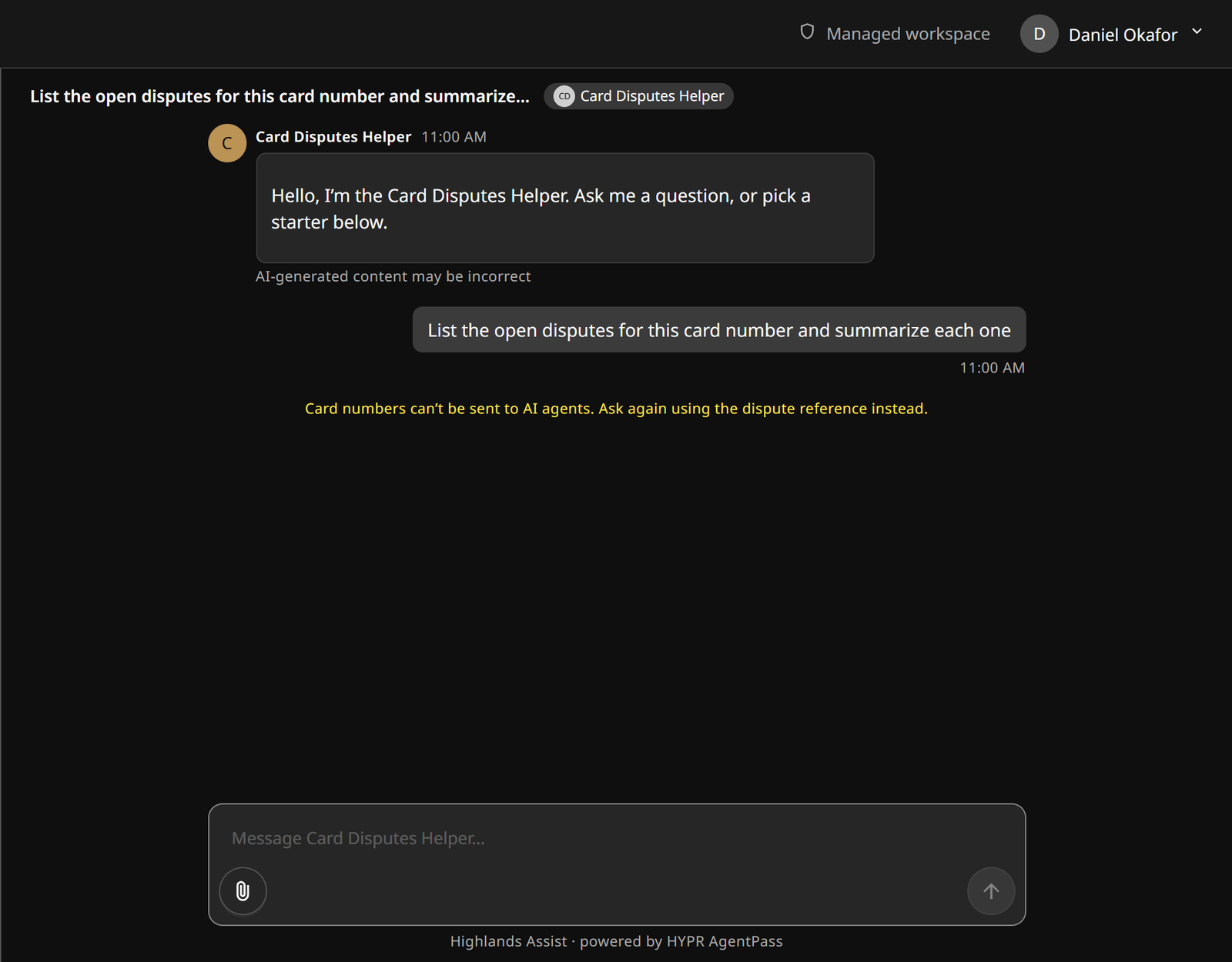
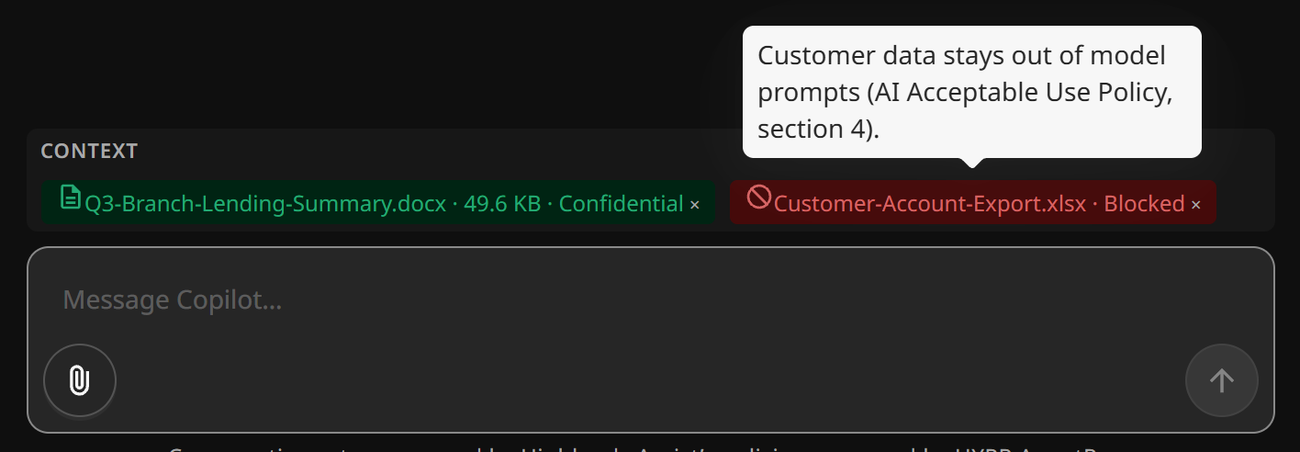
A file can also be turned away because of its format, not a rule. For example, a label reading Encrypted means the document is protected and can't be read, so upload an unprotected copy instead. Each label is explained in Upload a File from Your Computer.
To get past a block:
- Read the reason, if there is one. It usually tells you what to change.
- Ask again without the part the rule is about, such as a customer's details.
- If your work needs what the rule stops, ask your administrator. Include the notice's exact wording.
When an Action Is Waiting for Approval
Some actions need a person to say yes first. AgentPass holds the action and asks that person, called the agent's supervisor. Sometimes the person asked is you.
- Nothing happens until someone decides.
- If nobody answers in time, the request expires, and the action doesn't go ahead. An expired request is never treated as approved.
- If the answer is no, the action stops.
Where you see it:
- In the Agent Portal, there's no approval step. A rule that needs approval stops the message or file, the same way a block does.
- In Slack, the agent replies This needs your approval first, followed by what needs approving. Approve it in the HYPR app on your phone, then ask the agent again.
- In an AI tool on your computer, the first time the tool connects through AgentPass, its supervisor may need to approve it. The tool tells you that AgentPass paused the request until a supervisor approves access, and waits. If the tool can't wait, it says it doesn't have access yet, and that an approval request has been raised. Once the request is approved, send your message again. A later action can be held the same way. The tool then tells you the action is waiting for a supervisor's approval, and that it hasn't failed.
If the tool says it isn't registered with the gateway yet, it can't ask for approval itself. Ask your IT help desk to set it up, then try again.
Approval to use a tool lasts for a limited time, which your organization sets. When it ends, the tool asks again. That's expected.
When an Agent Is Turned Off
An agent's supervisor or your administrator can turn an agent off at any time, for example while they check what it has been doing. A turned-off agent refuses every request until someone turns it back on. Signing in again doesn't turn it back on.
You see one of these:
- In Slack, This agent has been turned off. Ask its owner or an administrator to turn it back on.
- In an AI tool on your computer, an error that reads This agent is turned off
To get it working again, ask the agent's owner or your administrator.
Notices at a Glance
This table lists each notice by place, with what to do.
| Where | What you see | What to do |
|---|---|---|
| Agent Portal, your organization's agent | A notice in place of the reply, with your organization's reason, or This request was blocked by a gateway policy. | Ask again without the part the rule is about, such as a customer's details |
| Agent Portal | A file label reading Blocked. Hover over it to see the reason | Remove the file, and ask without it |
| Agent Portal | A file label reading Encrypted | Upload an unprotected copy of the file |
| Agent Portal | This agent isn’t configured for chat yet. Ask your administrator to register it. | Ask your administrator. The agent may be turned off |
| Agent Portal | Couldn’t reach this agent right now. Please try again. | Try again later |
| Agent Portal | A message about a license, consent or registration | Ask your administrator. See If Something Goes Wrong |
| Slack | ⛔ with the rule's reason, or A policy blocked this request. | Ask again without the part the rule is about |
| Slack | This needs your approval first | Approve it in the HYPR app on your phone, then ask again |
| Slack | I need you to sign in to a named service | Open the request on your phone, and sign in to the service. On iPhone, tap Authenticate. Then ask again |
| Slack | The agent behind this channel is currently unavailable | Ask your administrator |
| Slack | The connected Microsoft 365 agent needs admin consent | Ask your administrator to grant consent, then try again |
| Slack | Your Microsoft 365 sign-in has expired | Sign in to the Agent Portal, then ask again |
| Slack | This agent has been turned off. | Ask its owner or your administrator. Once it's back on, your next message starts a new conversation |
| Your work computer | Blocked by policy, with the rule's name and reason | Ask again without the part the rule is about. You can stay in the same conversation |
| Your work computer | ⛔ Blocked by policy in the middle of a reply | The step it names didn't run. Try a different approach |
| Your work computer | This conversation still contains a request that a policy blocked | Start a new conversation |
| Your work computer | The request is paused until a supervisor approves access | Wait. The tool carries on once it's approved |
| Your work computer | I don't have access to this gateway yet | Once the request is approved, send your message again |
| Your work computer | I'm not registered with the gateway yet. | Ask your IT help desk to set the tool up, then try again |
| Your work computer | This agent is turned off | Ask its owner or your administrator |
| Your Mac's menu bar | AI Agent Blocked, or another AgentPass prompt | See What You See on a Mac |
Validate
You're set up when these work for the places you use AI:
- Agent Portal: after you sign in, the portal greets you by name, and an answer comes back to your first question.
- Slack: the agent answers in the thread of your message.
- Work computer: your AI tool answers as usual. On a Mac, the AgentPass icon is in the menu bar.
- Phone: AgentPass in the HYPR app shows your agents, and any requests waiting for you.
Logs and Audit Trail
AgentPass keeps a record of each request that passes through it, so your organization can see what its AI tools did and who asked. The record can include what you asked, the answer you got and what the rules decided. People your organization authorizes, such as administrators, can review it.
This is the same reason the tools act as you: every action can be traced to the person or agent behind it. On your work computer, requests a tool sends through AgentPass are recorded like any other request.
Common Questions
Do I need to install anything?
Not for the Agent Portal, which runs in your web browser. You need the HYPR app only if you approve requests. Your IT team tells you if your computer needs anything.
Why was my message blocked when it seemed harmless?
Rules can look for certain kinds of content, such as customer details, wherever it appears. Remove that part and ask again. If you still need it, ask your administrator.
Can the AI see more than I can?
No. The tools act with your own access. Copilot, for example, reads your email, calendar, Teams messages and OneDrive files, but only what your account can already open.
Why does a tool ask for approval again when it worked last week?
Approval to use a tool lasts for a limited time. When it ends, the tool asks again.
An agent I need isn't in the Agent Portal
Your administrator decides which agents the portal lists, and everyone sees the same list. Ask them to add it.
Can I stop one of my agents?
Yes. If an agent you look after does something you didn't intend, turn it off from the HYPR app straight away. You can turn it back on only if you turned it off yourself.
Getting Help
Your administrator, or your organization's IT help desk, is your first contact for anything AgentPass shows you. When you ask, include the exact wording of any message you see.
| If you see | Ask |
|---|---|
| A blocked message or file that your work needs | Your administrator, to review the rule |
| A request that has been waiting a long time | The agent's supervisor, or your administrator |
| This agent has been turned off, or This agent is turned off | The agent's owner, or your administrator |
| An AI tool on your computer saying it isn't registered with the gateway | Your IT help desk, to set it up |
| A message about a license, consent or registration in the Agent Portal | Your administrator |
| A request on your phone you don't recognize | Deny it, and tell your administrator |
Related
- Chatting in the Agent Portal — every Agent Portal feature, and each message it can show
- Being a Supervisor — for people responsible for agents
- Approving and Denying Agent Actions — what each answer does to the agent
- Onboarding Your Agent — point a coding agent at the gateway, and approve its first connection