HYPR AgentPass: How It Works
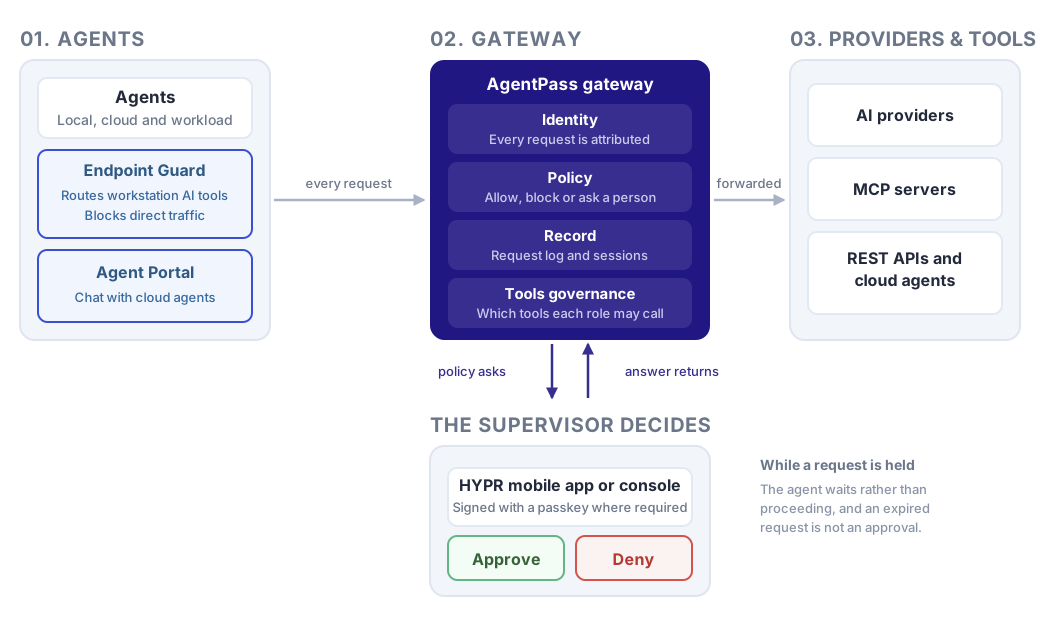
HYPR AgentPass™ sits between the agents your people run and the providers and tools those agents call. Every request is attributed to an agent and a person, checked against your policies and recorded. Where a policy asks for a person, a supervisor decides before the request goes on.
Agents
An agent is software that uses a model and tools to complete a task. AgentPass governs agents wherever they run:
- Local agents run on a person's workstation, such as Claude Code, Codex CLI and Cursor.
- Cloud agents are hosted by a provider, such as Anthropic, AWS Bedrock AgentCore and Microsoft 365 Copilot.
- Workload agents run on their own, with a named owner and a role and credential of their own.
Every agent appears on the console's Agents page. See Where Agents Run.
Guards and the Agent Portal
Two enforcement points bring agent traffic to the gateway.
| Enforcement point | Where it runs | What it does |
|---|---|---|
| Endpoint Guard | macOS and Windows workstations | Reports AI tool activity, routes supported tools to the gateway, provisions MCP servers and blocks direct traffic to providers |
| Agent Portal | The gateway, in a browser | Carries people's conversations with provider-hosted cloud agents, and applies the same controls to them |
See Endpoint Guard and Agent Portal.
Gateway
The gateway applies four controls to the traffic it carries.
| Control | What it does | Configure it in |
|---|---|---|
| Identity | Attributes every request to an agent, and to the person accountable for it | Identity |
| Policy | Allows a request, blocks it, or holds it for a person. A rule can check the request and, where you choose, the response | Policies |
| Record | Writes every request to the Request log, groups requests into sessions, and keeps them for as long as your retention settings allow | Request Log · Data Management |
| Tools governance | Decides which tools each role may see and call, which connectors an agent may reach, and how sensitive the data a tool handles is | Tools Governance |
Guardrails build on these controls. They track what a session has read, hold a risky action after the session reads untrusted content, and can pause a live session. The console marks Guardrails as Preview. See Input Guardrails.
Architecture: The Request Path follows one request through these controls in order.
Identity
A request carries one of three identities:
- The agent's own credential, which AgentPass issues and ties to an accountable owner
- The supervisor's identity, used directly by an agent working for that person, such as a coding agent on their workstation
- A scoped session token, which the gateway issues when a supervisor lets an agent use a tool on their behalf. The gateway keeps the tool's credential, and the agent never holds it
Supervision
When a policy requires approval, the gateway holds the request and asks the agent's supervisor. The supervisor chooses Approve or Deny on the HYPR mobile app, or on the console's Approvals page. A request nobody answers expires, and an expired request never counts as an approval.
With Require signed approvals set to Required (production), every approval must carry the supervisor's passkey signature, so the record shows the decision was theirs. Under Optional (soak), an approval can be recorded without a signature. A denial needs no passkey under either setting.
Agents and supervisors can also exchange messages on a two-way chat channel, and an agent can send one-way notifications to its supervisor. See Being a Supervisor.
Providers and Tools
Traffic the gateway allows goes on to the systems your connectors describe:
- AI providers, such as Anthropic, OpenAI, AWS Bedrock and Microsoft Foundry
- MCP servers and REST APIs
- Cloud-agent platforms
Where the gateway holds a tool's credential, it attaches it as it forwards the call, so the agent never sees it. A channel connector, such as Slack, works the other way: it brings people's messages in to a cloud agent. See Connectors.
Related
- Architecture: The Request Path: one request through the gateway, control by control
- Your First Governed Agent: put one agent through the gateway end to end
- HYPR AgentPass: Overview: what AgentPass is and who uses it
- Security Controls Reference: each control stated as a verifiable claim