Enrolling Desktops
Overview
HYPR AgentPass™ sees the AI tools on your desktops through signed activity reports from the Endpoint Guard. A desktop sends reports once it enrolls with your gateway. This capability was earlier called Agent Observability.
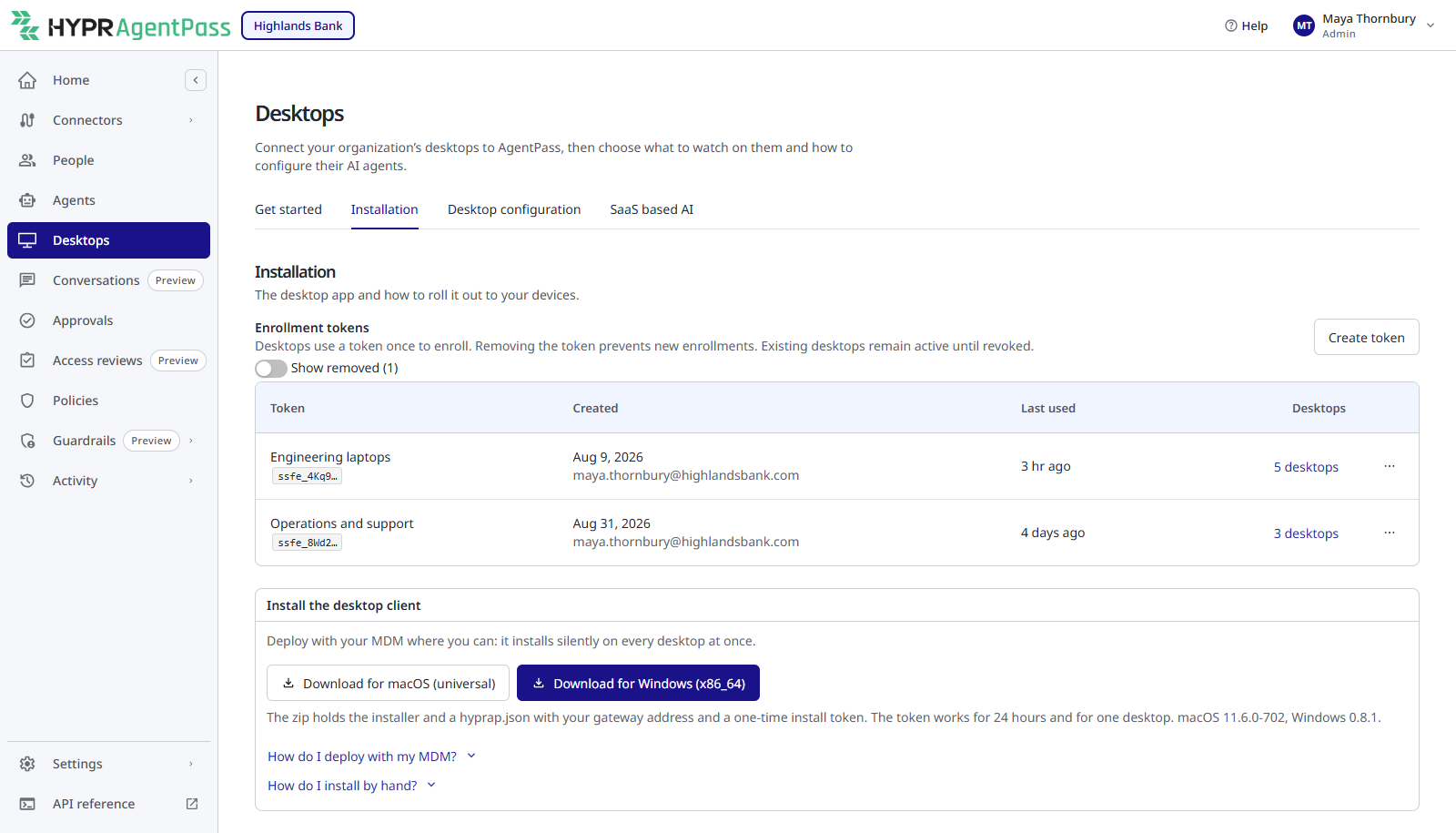
You manage enrollment on Desktops → Installation. There you create the enrollment tokens desktops use to register, see and revoke the desktops each token enrolled, and read the log of incoming reports. The Install the desktop client card on the same tab offers the Endpoint Guard installer for each platform. The Watch desktops switch, which lets desktops enroll and report, is on Desktops → Desktop configuration → Observation.
Opening the Desktops page, and reading tokens, desktops and the ingest-activity log, needs Settings: View, which Admin, Operator and Auditor have. Turning Watch desktops on or off, creating or removing a token, revoking a desktop or editing the watch list needs Settings: Edit, which Admin has.
Watch Desktops
Watch desktops is the switch for the whole desktop channel. While it is on, desktops with the client and an active enrollment token can enroll. Enrolled desktops report the AI agents they run, and apply your Desktop configuration and SaaS based AI settings. An agent already running when Endpoint Guard starts is reported too, with the time it started. Endpoint Guard's own processes, such as its sign-in checks, are not reported as agent activity. On macOS, neither are its channels or the Claude Code and Codex sessions they run.
Watch desktops is on by default. Upgrading AgentPass also turns it on for an organization that had turned it off. A desktop still needs an active enrollment token to enroll, so with no token, nothing enrolls.
While Watch desktops is off, the gateway accepts no enrollments or reports. Enrolled desktops stop reporting and stop receiving your settings. Your enrollment tokens, your enrolled desktops and what they already reported are kept.
To turn it off or on:
- Open Desktops → Desktop configuration, and choose Observation.
- Click the Watch desktops switch. A dialog lists what changes.
- Click Turn off or Turn on to confirm.
The switch cannot be turned on before an active enrollment token exists. While it is off, the Installation tab shows Watch desktops is off, so computers can't connect., with a Turn on button. After you turn it on, install again on any computer that tried to connect while it was off.
Enrollment Tokens
Desktops register with your gateway using an enrollment token. A desktop presents a token once, when it enrolls. From then on, it reports under its own signed identity, and uses a token again only if it has to re-enroll. Your organization can keep up to 25 active enrollment tokens, so you can give each rollout its own.
The Enrollment tokens table on the Installation tab lists every active token:
| Column | What it shows |
|---|---|
| Token | The name you gave the token, or Unnamed, with the token's first characters beneath, so you can match it to a deployment |
| Created | When the token was created, with the administrator who created it beneath |
| Last used | How long ago a desktop last enrolled with the token, or Never |
| Desktops | How many desktops enrolled with the token. Click the count to see them |
Create one token per rollout, for example one per device-management group or office. Each token then shows how many desktops it enrolled. If a token is exposed, you can remove it and revoke its desktops without touching any other rollout.
Create a Token
- On Desktops → Installation, click Create token.
- Optional: In Name (optional), enter a name that helps you tell tokens apart, for example
Finance laptops. Names can be up to 80 characters. - Click Create.
- In the Copy your enrollment token now dialog, click Copy, and place the token in your desktop client deployment. Then click Done.
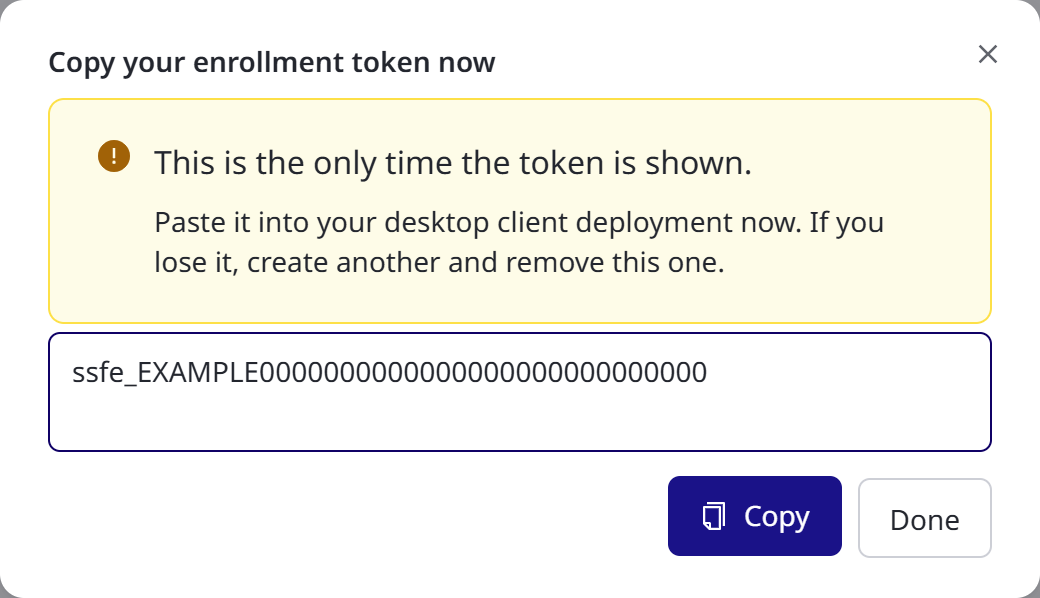
An enrollment token is shown in full only once, in the Copy your enrollment token now dialog. The gateway keeps only a one-way fingerprint of it, and can never display it again. If you lose a token, create another, and remove the one you lost.
Treat every enrollment token like a password. Anyone who holds an active token can enroll a device into your organization until you remove it.
Remove a Token
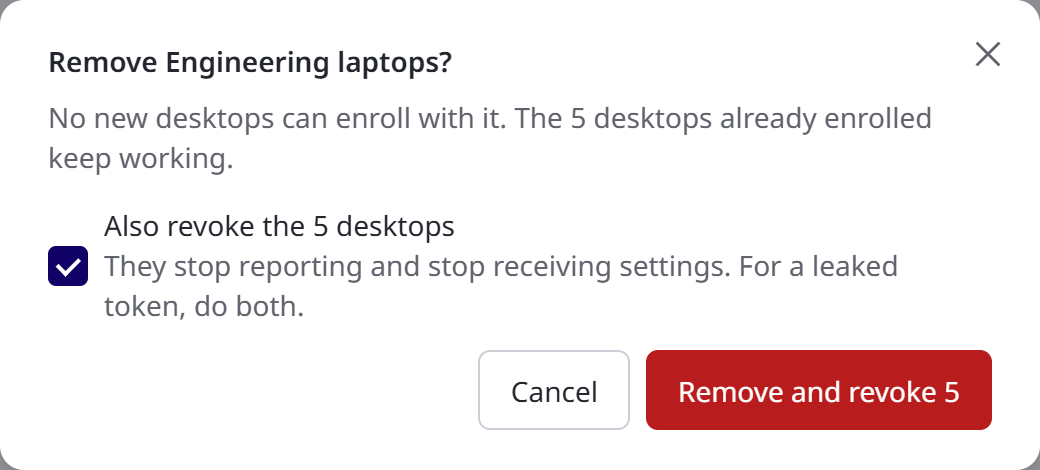
Removing a token stops new enrollments with it, immediately. A desktop that presents a removed token is refused, as if the token had never existed. Desktops that already enrolled with the token keep working, unless you also revoke them.
- Open the token's menu (⋯), and choose Remove token….
- Optional: Select Also revoke the N desktops. They then stop reporting and stop receiving settings as well. For a leaked token, do both.
- Click Remove. When you also revoke the desktops, the button reads Remove and revoke N.
A desktop that later needs to re-enroll must present an active token. Before you remove a token, make sure the deployments that still rely on it have a replacement.
Removed tokens are hidden from the table. Turn on Show removed to see them, with who removed each one. They stay listed, so you can always see which tokens existed, who created them and who removed them.
Replace a Token
Replace a token on a routine schedule, or when you believe it is no longer trustworthy:
- Create a new token.
- Update your desktop client deployment to use it.
- Remove the old token.
Each token is independent, so desktops keep enrolling with the old token until you remove it. There is no gap while you roll out the new one.
Tokens From Before Multiple Tokens Were Supported
If your organization enrolled desktops before it could keep several tokens, the token you already had keeps working with no action from you. It appears in the table as Original token, with the administrator who last set it and when. Desktops that enrolled before the change are counted under Original token, even if they originally enrolled with an earlier token that has since been replaced.
Review and Revoke Desktops
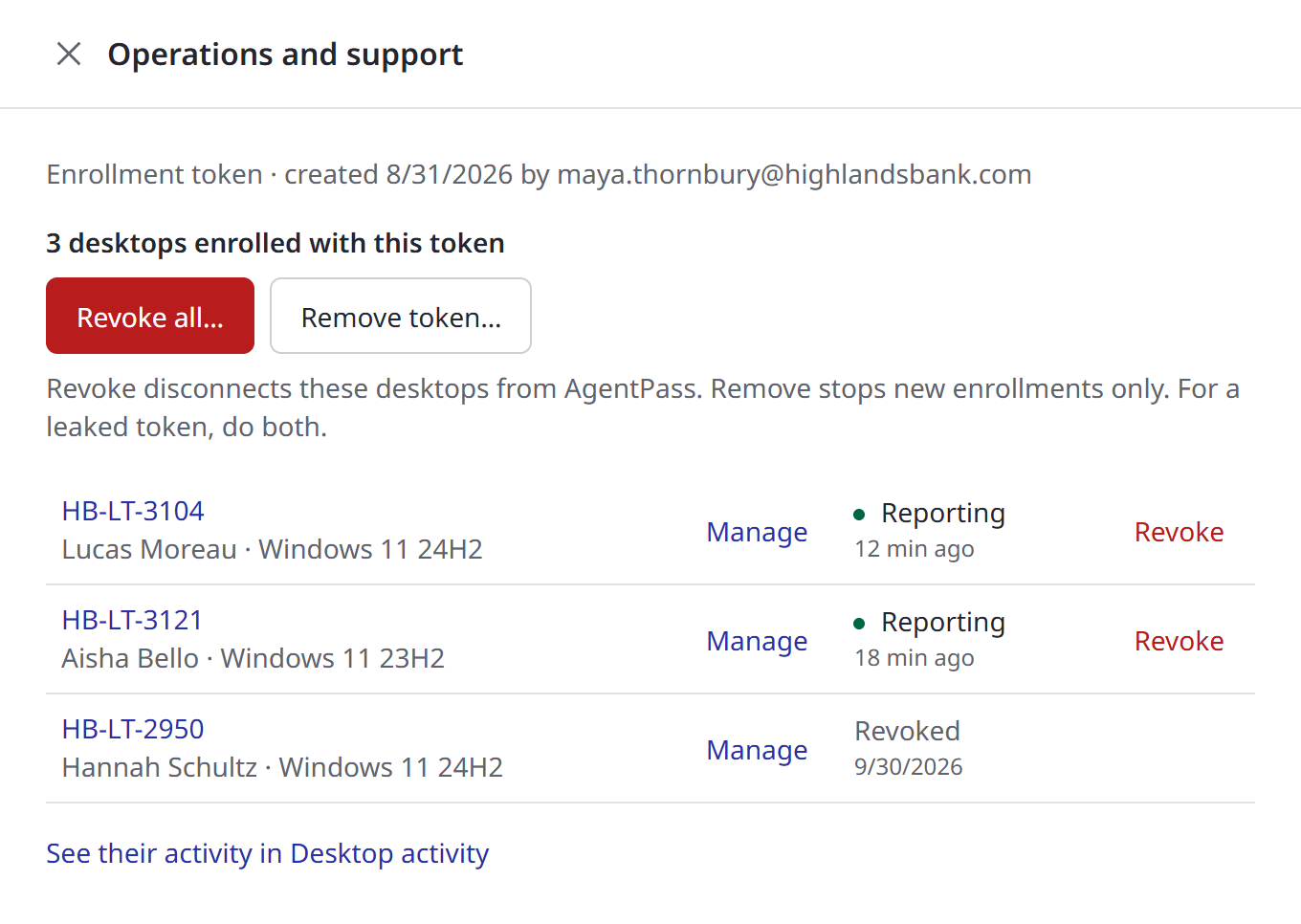
Each token keeps its own list of desktops. To open it, click the count in the token's Desktops column, or choose Show desktops from the token's menu. A panel opens with the desktops enrolled with that token.
Each desktop shows its computer name, the person it enrolled under, its operating system and its status:
| Status | Meaning |
|---|---|
| Reporting | The desktop reported recently. How long ago is shown beside it |
| Not reporting | The desktop has sent no report for more than a day |
| Not reported yet | The desktop enrolled, but has not reported yet |
| Revoked | The desktop was revoked. The date is shown beside it |
From the panel, you can:
- Click Manage to change one desktop's settings. See Managed Desktops.
- Click Revoke on a desktop, then Revoke to confirm. It stops reporting and stops receiving settings.
- Click Revoke all…, then Revoke all, to revoke every active desktop enrolled with the token.
- Click Remove token… to remove the token itself.
- Click See their activity in Desktop activity to see what these desktops report.
Revoke a desktop when it is retired or reassigned, or when you do not recognize it. A revoked desktop does not return to active. To report again, it must enroll afresh with an active enrollment token, and it then appears as a new desktop. The gateway refuses to re-enroll the revoked identity, so the desktop enrolls with a fresh one. The gateway keeps activity the desktop reported before it was revoked.
The Endpoint Guard uninstaller removes the desktop from the gateway, which then lists it as revoked. See Endpoint Guard for macOS and Endpoint Guard for Windows. An update on Windows keeps the same desktop, and changes its client version.
Every enrolled desktop, with its hardware, client version and operating system, is also listed on the By desktop tab of Activity → Desktop activity. See Desktop Activity.
Read the Ingest-Activity Log
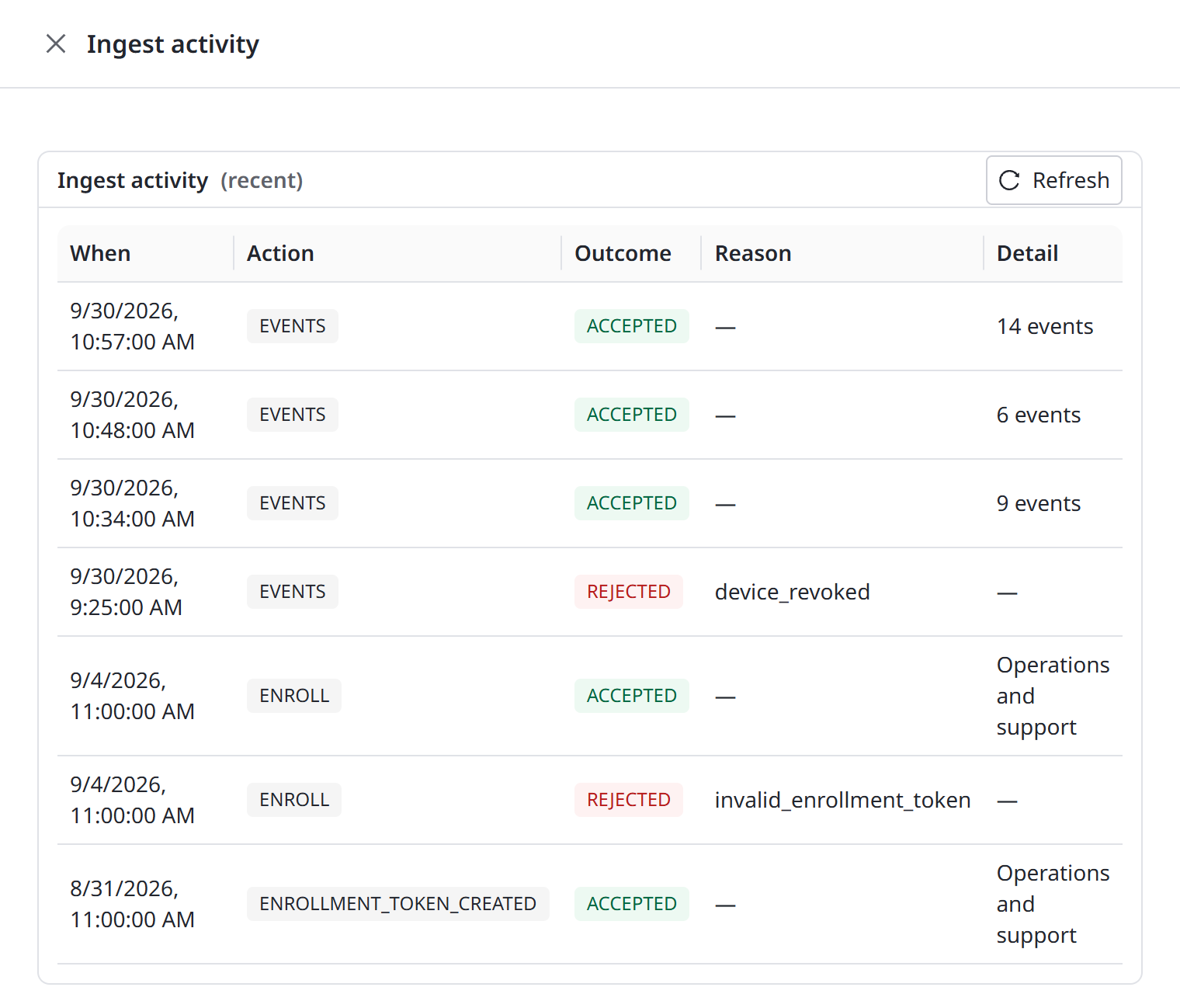
The Ingest activity log records what the gateway does with each enrollment and each batch of reports. Use it to confirm desktops are reporting, and to spot any the gateway turns away.
To open it, click See ingest activity at the end of Desktops → Installation. Click Refresh to pull the latest entries.
| Column | What it shows |
|---|---|
| When | When the gateway handled the request |
| Action | What happened: ENROLL for an enrollment, UPGRADE for a desktop reporting a newer client after an update, EVENTS for a batch of activity reports, REVOKE for a revoked desktop, ENROLLMENT_TOKEN_CREATED and ENROLLMENT_TOKEN_REVOKED for an administrator creating or removing a token, MANAGED_MODE for an administrator turning Configure agents from AgentPass on or off, or MANAGED_OVERRIDE for an administrator changing or resetting one desktop's settings |
| Outcome | ACCEPTED or REJECTED |
| Reason | Why a request was rejected. For example, an invalid enrollment token, too many failed enrollments from one network address, a report from a desktop that is no longer active, a report that was not fresh, or a desktop sending too many reports |
| Detail | For an accepted batch, how many activity records it contained. For an update, the client version before and after. For a revocation, who performed it, or that the desktop removed itself when Endpoint Guard was uninstalled. For a token change, the token's name or first characters, and who made the change. For a configuration or desktop change, what changed and who made it |
Routine checks for new settings are not logged. A healthy fleet therefore shows a steady stream of accepted EVENTS entries, not one line per check-in. Use the log to:
- Confirm reporting is healthy. Look for accepted batches from the desktops you expect.
- Investigate a quiet desktop. Check whether its enrollment succeeded and its reports are arriving.
- Notice rejected reports. See when reports are declined, and why.
The gateway keeps observed desktop activity and the ingest-activity log for as long as your Data Management settings say.
Related
- Getting Started with Desktops — the setup checklist on the Desktops page
- Agents Observation — choose which AI agents desktops watch
- Desktop Activity — review what desktops report