Endpoint Guard for Windows
Endpoint Guard for Windows enrolls the workstation, discovers supported AI tools and sends signed activity reports to AgentPass. On Windows, it works with Claude Code, the Codex CLI and Cursor. It recognizes Claude Code however it was installed, including through the VS Code extension and the copy that comes with Claude Desktop. The Windows client supports Agent Observability and Managed Desktop Tools: routing, MCP provisioning, Cursor hooks and egress enforcement. Claude and Codex channels require the macOS client.
On Windows, an egress block applies to every process on the workstation, browsers included.
Endpoint Guard for Windows also reports which SaaS AI apps people reach, in the browser or from desktop apps, for SaaS Based AI. It reports and does not block: an app you block is still counted, and stays reachable.
Endpoint Guard for Windows is in early access and in active development. Its capabilities, installer options and behavior can change between versions. Confirm the version to deploy, and what it supports, with your HYPR representative.
Complete support for Claude Desktop on Windows is planned for a future version. Today, the installer can set Claude Desktop to use your gateway, Endpoint Guard reports Claude Desktop as its own tool, and a Claude Desktop egress block set in the console applies to the whole workstation. Managing Claude Desktop's routing and MCP servers from the console requires the macOS client.
Who Provides What
A workstation needs three things before it can enroll: the installer, your gateway address and an enrollment token. Each comes from a different place.
| Who | What they provide | Where it comes from |
|---|---|---|
| HYPR | The installer | Desktops → Installation in the console, or your HYPR representative |
| An AgentPass administrator | The gateway address and an enrollment token, with Watch desktops on | The AgentPass console |
| Whoever installs Endpoint Guard: your IT team, or a user with local administrator rights | The installation, with the gateway address and token | A deployment tool, or the installer on the workstation |
| The end user | Nothing to enter. They restart their AI tools afterwards | — |
The enrollment token is not a user's password, and nobody signs in with it. An administrator creates it in the console, and it reaches the workstation through the installation: in a deployment tool's command line, or pasted into the installer. The workstation presents it when it enrolls. One token can enroll any number of workstations, so a single token can cover a whole rollout.
Before You Begin
Prepare the AgentPass Console
An AgentPass administrator with permission to edit settings does this once, before the first installation:
-
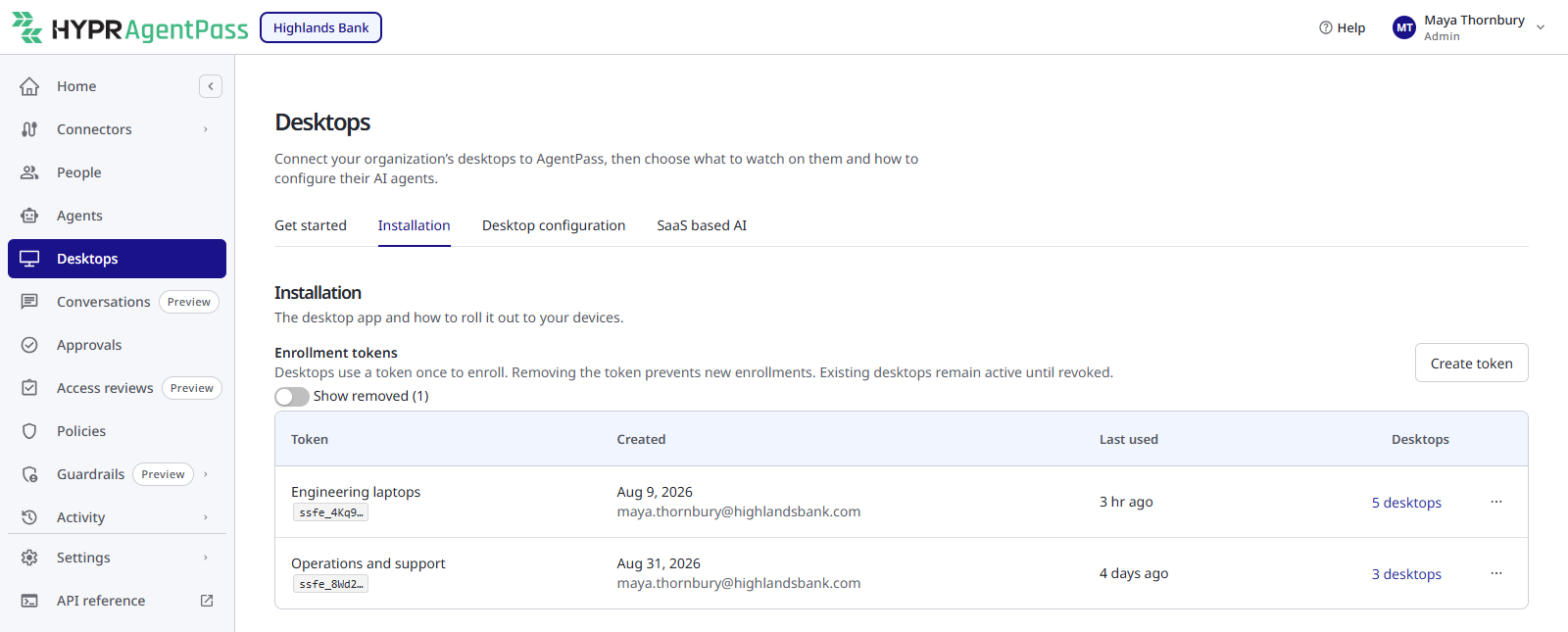
In the console, open Desktops, and click the Installation tab.
-
Click Create token, optionally give it a name, such as
Windows rollout, and click Create. Copy the token from the dialog, and keep it for the installation. The console shows it only once. See Create a Token. -
Make sure Watch desktops is on. It is on by default. While it is off, the gateway refuses enrollments, so installed workstations cannot enroll, and the Installation tab says so. See Watch Desktops.
-
Note your gateway address. It is the address your AgentPass console opens at, without
/admin/ui/. If the console is athttps://agentpass.example.com/admin/ui/, the gateway address ishttps://agentpass.example.com.
To route, provision or block AI tools on the workstations, also set up Agent Configuration. You can do that before or after the installation. Enrolled workstations pick up the configuration on their next poll.
Endpoint Guard for Windows does not use the If AgentPass can't be reached setting. While a workstation cannot reach the gateway, it keeps applying the last configuration it received, even after a restart. Egress blocks stay in place, and tools routed through the gateway stop working until it answers again. This is the same as Stop traffic, whatever you choose in the console or in a desktop's own settings.
Check the Workstation
- Windows 11 version 24H2 or later, on an x64 or ARM64 processor
- Local administrator rights for whoever runs the installer
- Outbound HTTPS from the workstation to your gateway address
A workstation with a Trusted Platform Module (TPM) protects its signing key there. Other workstations use the Windows Software Key Storage Provider.
Install Endpoint Guard
Download the installer from Desktops → Installation in the console, which offers a download for each platform your gateway has installers for. The download is a zip that holds the installer. When the tab reads Installers aren’t available right now, get the installer from your HYPR representative. There is one for each processor: EndpointGuard-X64-<version>-<date>-Setup.exe for x64 workstations and EndpointGuard-ARM64-<version>-<date>-Setup.exe for ARM64 workstations. Each is a single file, named for its version and build date.
The installer puts Endpoint Guard in C:\Program Files\HYPR AgentPass, starts the HYPR AgentPass Endpoint Guard Service, and adds HYPR AgentPass Endpoint Guard to Settings > Apps.
On a new installation, the installer checks that your gateway answers and that the token is in the right format. It stops if either check fails. It does not check whether the token is still active, or whether Watch desktops is on. A workstation with a removed or mistyped token can install normally, then keep trying to enroll and never appear in the console. Confirm every workstation afterwards. See Confirm Enrollment.
Install From a Deployment Tool
To install on many workstations at once, run the installer from a deployment tool, such as Microsoft Intune or Configuration Manager. Give it /quiet, /accepteula, the gateway address and a file that holds the enrollment token:
EndpointGuard-X64-<version>-<date>-Setup.exe /quiet /accepteula /server=https://<your-gateway-address> /tokenfile=token.txt
The examples use the X64 installer; on ARM64 workstations, use the ARM64 one. Switches start with / or -, and a value follows = or :. Run the installer with /? to list them.
| Switch | Effect |
|---|---|
/quiet | Installs with no user interface. On a workstation where Endpoint Guard is installed, updates it instead |
/accepteula | Accepts the End User License Agreement. Required for a quiet new installation |
/server=<url> | The gateway address, over HTTPS |
/tokenfile=<path> | Reads the enrollment token from this file, then deletes it. A relative path starts from the installer's folder. See Deliver the Enrollment Token |
/token=<token> | The enrollment token itself. A new installation needs /tokenfile or /token, not both |
/proxy=<url> | A proxy for the installer's gateway check, such as http://proxy.example.com:8080, for networks where the workstation can't reach the gateway directly. The service keeps using the workstation's own proxy settings |
/noclaudecode | Leaves out the Claude Code setup on a new installation |
/claudedesktop | Sets up Claude Desktop. A new installation does this by default |
/noclaudedesktop | Leaves out the Claude Desktop setup |
/loglevel=<level> | Sets the service's log level: Fatal, Error, Warn, Info, Debug or Trace |
/uninstall | Removes Endpoint Guard. Add /quiet to remove it with no user interface |
/log=<path> | Writes the setup log to this file. A relative path starts from the installer's folder. See Setup Logs |
/? | Lists the switches |
The installer authenticates to a proxy as the computer, so a /proxy address with a user name or password is refused.
Before a new installation changes anything, the installer checks that your gateway answers. If the gateway can't be reached, the installer returns 1618, and your deployment tool tries again later. Nothing is installed until the check passes.
The installer returns Windows Installer exit codes, which deployment tools read directly:
| Exit code | Meaning |
|---|---|
0 | Success |
87 | A switch is missing or not valid, /accepteula is missing, or the token file can't be used. The setup log has the reason |
1602 | Canceled |
1603 | The installation, update or removal failed. This includes a damaged installer file, and a gateway that answers but can't be used, such as one whose certificate isn't trusted. The setup log has the reason |
1618 | Try again later. Another Endpoint Guard installation is running on the workstation, or the gateway can't be reached. The setup log says which |
1633 | The installer is for the other processor. Use the X64 installer on x64 workstations and the ARM64 installer on ARM64 workstations |
1638 | A newer version is already installed. Remove it first to install an older one |
To run the installer by hand from an administrator command prompt, wait for it to finish, so you can read its exit code. The installer is a Windows program, and a command prompt doesn't wait for one on its own:
start /wait EndpointGuard-X64-<version>-<date>-Setup.exe /quiet /accepteula /server=https://<your-gateway-address> /tokenfile=token.txt
echo %ERRORLEVEL%
In PowerShell, use Start-Process with -Wait and -PassThru:
$setup = Start-Process -FilePath .\EndpointGuard-X64-<version>-<date>-Setup.exe -ArgumentList '/quiet', '/accepteula', '/server=https://<your-gateway-address>', '/tokenfile=token.txt' -Wait -PassThru
$setup.ExitCode
Deliver the Enrollment Token
Put the token in a text file, and pass the file with /tokenfile. The token then stays out of the deployment's command line and its logs, and the setup log shows only the file's path. The installer reads the file, then deletes it. When the installer returns 1618, it keeps the file for the retry.
The installer runs as SYSTEM, so it refuses a token file that someone without administrator rights could change or replace. It returns 87, logs the reason and leaves the file where it is, unless:
- Only SYSTEM, the Administrators group, or the account running the installer can change the file and its folder
- No folder on the file's path is a link or a junction
- The file is an ordinary file of at most 4 KB, with no other links to it
A token file packaged with the installer in Intune or Configuration Manager meets these conditions. To copy the file to the workstation yourself, put it in a folder only administrators can change, owned by the Administrators group. A new folder at the root of C: lets every user change its contents, so a token file there is refused. When the setup log reports that the token file was refused, the log names the condition it did not meet.
Anyone with the token can enroll a workstation in your organization. Limit who can read the deployment package. With /token, the token is also in the deployment's command line, so limit who can read the deployment and its logs too. If a token is exposed, remove it in the console and create a new one. Workstations that already enrolled keep reporting.
Deploy With Microsoft Intune
Add Endpoint Guard to Intune as two Windows apps (Win32), one for each processor, installed in the device (SYSTEM) context. Set up each app the same way, with its own installer:
-
Put one installer and
token.txtin a folder, and package the folder with the Microsoft Win32 Content Prep Tool. -
In the Intune admin center, add a Windows app (Win32), and upload the
.intunewinfile. -
On Program, set the install command:
EndpointGuard-X64-<version>-<date>-Setup.exe /quiet /accepteula /server=https://<your-gateway-address> /tokenfile=token.txt -
Set the uninstall command:
EndpointGuard-X64-<version>-<date>-Setup.exe /uninstall /quiet -
Set Installation behavior to System.
-
Keep the default return codes. They already mark
1618as Retry, so Intune tries again later when the gateway can't be reached. -
On Requirements, set the operating system architecture to x64 for the X64 app or ARM64 for the ARM64 app, and the minimum operating system to Windows 11 24H2. Each workstation then gets only the app for its processor.
-
On Detection rules, add a Registry rule with these settings:
- Key path:
HKEY_LOCAL_MACHINE\SOFTWARE\Microsoft\Windows\CurrentVersion\Uninstall\HyprAgentPass - Value name:
DisplayVersion - Detection method: Version comparison, Greater than or equal to, and the installer's version, such as the
<version>in its file name - Associated with a 32-bit app on 64-bit clients: No
- Key path:
-
Assign the app to a test group first. Check that those workstations appear in the console before you assign it more widely. See Confirm Enrollment.
To deploy a newer version, add it the same way, and set it to supersede the earlier app. The newer installer updates each workstation in place, and the workstation keeps its enrollment.
Deploy With Configuration Manager
Create an application with two Script Installer deployment types, one for each processor. For each, set:
- Installation program: the same command as for Intune, with
/quiet /accepteula /server=… /tokenfile=token.txt, andtoken.txtin the content folder - Uninstall program:
EndpointGuard-X64-<version>-<date>-Setup.exe /uninstall /quiet, with that deployment type's installer - Requirements: the operating system architecture, x64 or ARM64
- Detection method: a registry setting in
HKEY_LOCAL_MACHINE, keySOFTWARE\Microsoft\Windows\CurrentVersion\Uninstall\HyprAgentPass, valueDisplayVersion, data type Version, Greater than or equal to the installer's version. Leave the 32-bit application option cleared - Installation behavior: Install for system, whether or not a user is signed in
Keep the default return codes, which treat 1618 as a retry.
Other Deployment Tools
Any tool that runs a command as SYSTEM can deploy Endpoint Guard with the same install and uninstall commands. Detect it by the same registry value.
Endpoint Guard's entry in Settings > Apps also carries a quiet removal command, so tools that read it can remove Endpoint Guard with no user interface. For example, from an administrator command prompt:
winget uninstall --name "HYPR AgentPass Endpoint Guard" --exact --silent
Deploy with your MDM where you can. It installs Endpoint Guard silently on every workstation at once.
- Use one token per rollout group. Each token then shows how many workstations enrolled with it, and you can remove one group's token without touching another's.
- Change settings with the MDM, not a reinstall. To move workstations to a different gateway address or token, push the registry values in Change the Gateway Address or Enrollment Token from the same MDM.
Install on One Workstation
Whoever installs needs local administrator rights, the gateway address and the enrollment token. To list the command-line switches instead, run the installer with /?.
-
Double-click the installer, and allow it to make changes to the workstation.
-
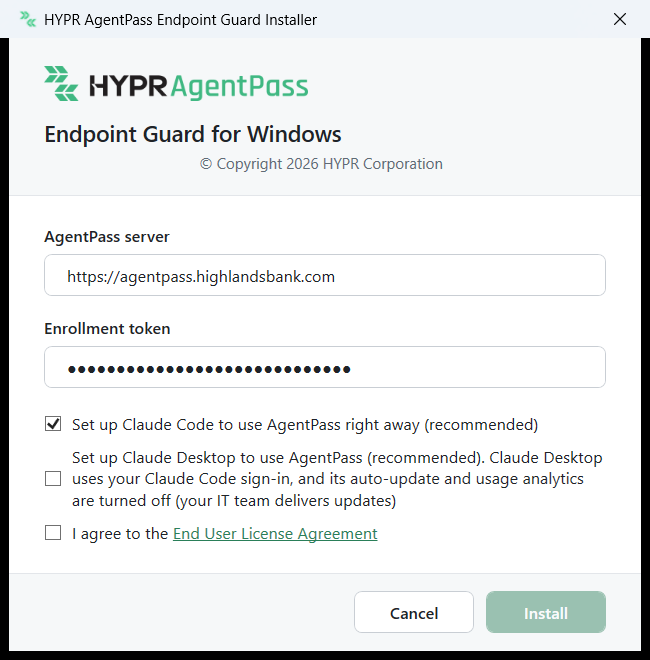
In AgentPass server, enter the gateway address.
-
In Enrollment token, paste the token. It starts with
ssf_. -
Choose the options. Both appear on every workstation, and both are selected by default.
- Set up Claude Code to use AgentPass right away (recommended) applies Claude Code's settings at once, instead of after the user's next Windows sign-in.
- Set up Claude Desktop to use AgentPass right away (recommended), even if it isn't installed yet sets Claude Desktop to send its requests to your gateway with the user's Claude Code sign-in, and turns off its automatic updates and usage analytics, so your IT team delivers its updates. If Claude Desktop is not installed yet, the setting takes effect once it is. On a workstation without Claude Code, the user signs in from Claude Desktop's Code tab. The user restarts Claude Desktop afterwards. The installer leaves any Claude Desktop policy your organization already set under
HKLM\SOFTWARE\Policies\Claude.
-
Select I agree to the End User License Agreement, and click Install.
Update Endpoint Guard
Run the newer installer. On a workstation where Endpoint Guard is installed, it offers Update, or Reinstall for the same version, in place of the installation form. /quiet updates without asking. The workstation keeps its enrollment, so an update needs no token and no /accepteula.
After the update, the installer tells your gateway the version now installed. The console then shows the same desktop with its new client version, and the ingest-activity log records an accepted UPGRADE entry. If the workstation can't reach the gateway during the update, the update still completes, and the setup log records that the gateway was not told.
The installer also updates a workstation set up with an earlier version from the command line. It moves Endpoint Guard to C:\Program Files\HYPR AgentPass, and the workstation keeps its enrollment. If you unzipped the earlier version into another folder, delete that folder afterwards.
An update keeps the Claude Desktop choice made at installation. To change it, add /claudedesktop or /noclaudedesktop to the update. /noclaudedesktop removes the Claude Desktop settings the installer added, and leaves any your organization set. A workstation set up with an earlier version has no recorded choice, so the update sets up Claude Desktop on it, unless you add /noclaudedesktop.
An update also applies /loglevel. It ignores /server, /token, /tokenfile and /noclaudecode, and the setup log names each one it ignored. A token file given to an update is deleted. To change the gateway address or token, see Change the Gateway Address or Enrollment Token.
Change the Gateway Address or Enrollment Token
You can point an installed workstation at a different gateway address, or give it a different enrollment token, without removing Endpoint Guard. The service watches its registry settings. When either value changes, the workstation enrolls again with the new value, with no restart.
Running the installer again does not change these values. On a workstation where Endpoint Guard is installed, the installer ignores /server and /token.
To change them from a deployment tool or Group Policy, set these registry values as strings (REG_SZ):
| Registry key | Value name | Contents |
|---|---|---|
HKLM\SOFTWARE\HYPR AgentPass | Server URL | The gateway address, over HTTPS |
HKLM\SOFTWARE\HYPR AgentPass\Protected | Enrollment Token | The enrollment token |
Write the token as plain text. The service encrypts it in place as soon as it reads it. Only SYSTEM and the local Administrators group can open the Protected key, so run the deployment as one of them.
To change them on one workstation, open a command prompt as an administrator in C:\Program Files\HYPR AgentPass, and run:
.\Hypr.AgentPass.Cli.exe reset /server=https://<your-gateway-address> /token=<enrollment-token>
Leave out either switch to keep its current value. The reset command reinstalls the service in place with the new values, and the workstation enrolls again.
After either change:
- Revoke the old desktop. Enrolling again gives the workstation a new signing key, so it appears in the console as a new desktop. Revoke the earlier entry on Desktops → Installation. See Review and Revoke Desktops.
- Update Claude Desktop after a new gateway address. If the installer set up Claude Desktop, run the same installer again, and click Reinstall, or run it with
/quiet. This sets Claude Desktop to the new gateway address. The workstation keeps its enrollment.
Browser Settings for SaaS Based AI
Microsoft Edge, Google Chrome and Mozilla Firefox can look up website addresses themselves, instead of asking Windows. Endpoint Guard sees only the lookups that go through Windows. So the installer sets browser policy that sends these three browsers' lookups through Windows, and their visits to SaaS AI apps are reported.
The installer sets these values on the workstation:
| Browser | Registry key (HKLM) | Value name | Type | Data |
|---|---|---|---|---|
| Microsoft Edge | SOFTWARE\Policies\Microsoft\Edge | BuiltInDnsClientEnabled | REG_DWORD | 0 |
| Microsoft Edge | SOFTWARE\Policies\Microsoft\Edge | DnsOverHttpsMode | REG_SZ | off |
| Google Chrome | SOFTWARE\Policies\Google\Chrome | BuiltInDnsClientEnabled | REG_DWORD | 0 |
| Google Chrome | SOFTWARE\Policies\Google\Chrome | DnsOverHttpsMode | REG_SZ | off |
| Mozilla Firefox | SOFTWARE\Policies\Mozilla\Firefox\DNSOverHTTPS | Enabled | REG_DWORD | 0 |
The installer sets a value only where none exists. It never changes a value your organization set, by Group Policy or any other way. Uninstalling removes only the values the installer set.
Other browsers are not covered. Their visits to SaaS AI apps may not be reported.
A browser reads its policy when it starts. After the installation, people close and reopen their browser. Microsoft Edge can keep running in the background after its windows close, so signing out of Windows, or restarting, is the dependable way.
Set the Browser Policy Yourself
To manage these settings centrally, set the same policies from Group Policy or your MDM before you install. The installer then leaves them as they are.
- Microsoft Edge and Google Chrome: set
BuiltInDnsClientEnabledto disabled, andDnsOverHttpsModetooff. - Mozilla Firefox: set the
DNSOverHTTPSpolicy withEnabledturned off.
If you manage Chrome or Edge from a cloud management console, set the same policies there too, so the console and the workstation agree.
Check the Browser Policy
Each time the service starts, it checks the five values. For each browser whose values are missing or different, it writes one warning to its log. The warning starts with Browser policy:, and names the browser and the value. See Logs and Service Events.
Confirm Enrollment
The console is where you see that a workstation enrolled. In the console, open Desktops → Installation, and click the count in the Desktops column of the token it was installed with. The workstation is listed by its computer name, with the status Reporting or Not reported yet. See Review and Revoke Desktops. It is also listed on the By desktop tab of Activity → Desktop activity.
If a workstation does not appear, check that:
- Watch desktops is on
- The token it was installed with is still active, not removed
- The gateway address is the one your console opens at
The service records a failed attempt as Enrollment failed in its log, and tries again. To enroll a workstation with a different token or gateway address, see Change the Gateway Address or Enrollment Token.
To check that the service is running, open a command prompt in C:\Program Files\HYPR AgentPass, and run:
.\Hypr.AgentPass.Cli.exe status
It reports whether the service is running, not whether the workstation enrolled.
Once the workstation has enrolled, matching tool activity appears in Desktop Activity. The service subscribes to Windows process start and stop events, matches them against your published observation manifest, and reports the signed-in user with each activity. Programs that do not match the manifest are discarded on the workstation.
What Users Notice
Endpoint Guard runs in the background as a Windows service, and users keep working in their AI tools as before. Tell them about these changes before you install:
- Restart AI tools after the installation. A tool picks up its new configuration when it starts. When AgentPass routes a tool through an environment variable, the setting applies to programs started after the user's next Windows sign-in. Ask users to sign out and back in, then restart the tool.
- Signing in works while enforcement is on. Users can sign in to Claude Code and Codex at any time. While one of them is not signed in, its block pauses until sign-in completes, and its routing stays in place.
- Install AI tools first. On Windows, an egress block applies to the provider's network addresses, for every process, and covers HTTP/3 as well. Hosts that share an address are blocked together, so blocking
api.anthropic.comfor Claude Code also blocksclaude.ai, in the browser too. A blocked provider's website is blocked too, so it can't be used to download its tool. Ask users to install Claude Code and their other AI tools before you turn on enforcement for those tools. - A blocked connection appears in the tool. When Endpoint Guard blocks a connection, the tool reports a connection error or stops responding. Endpoint Guard shows no message of its own. If a tool stops working after you turn on enforcement, check that it is set up to use the gateway.
- Restart the browser after the installation. Until then, the browser's visits to SaaS AI apps may not be reported. See Browser Settings for SaaS Based AI.
Logs and Service Events
Endpoint Guard writes diagnostic logs to:
C:\ProgramData\HYPR AgentPass\Logs\
Only members of the local Administrators group can access the log files.
Enrollment tokens and signing keys are not written to the logs.
Service start, stop and failure events also appear in the Windows Application event log.
Setup Logs
The installer writes a log each time it runs. The log ends with a RESULT: line, which gives the exit code and its reason. Without /log, quiet runs write it to:
C:\ProgramData\HYPR AgentPass Setup\Logs\HYPR-AgentPass-Setup-<date>-<time>.log
Only members of the local Administrators group can open these logs. They stay after Endpoint Guard is removed. Runs with the installer's window write their log to the temporary folder instead. The enrollment token is never written to a setup log.
To collect a setup log from Intune, open the failed app's installation details, select Collect diagnostics, and enter the log's full path. Intune needs a fixed file name, so give one in the install command:
"/log=C:\ProgramData\HYPR AgentPass Setup\Logs\EndpointGuard-Setup.log"
Each run adds to the end of that file.
If the installer can't use C:\ProgramData\HYPR AgentPass Setup, for example because another account created it first, it stops with 1603 before it changes anything. It writes no log there. Instead, it records the reason in the Windows Application event log, as an error from the source HYPR AgentPass Setup. The message says what to remove. An administrator deletes the folder, then runs the installer again.
Remove Endpoint Guard
Open Settings > Apps, find HYPR AgentPass Endpoint Guard, and uninstall it. You can also run the installer again and click Uninstall, or run it with /uninstall /quiet from a deployment tool.
Uninstalling reverts the routing, MCP and hooks settings the service added to each tool. It also removes the Claude Desktop and browser settings the installer wrote, and deletes the installation folder.
Before it removes anything, the uninstaller tells your gateway, which then lists the workstation as Revoked. The ingest-activity log records a REVOKE entry for it. Installing Endpoint Guard again later adds the workstation as a new desktop.
If the workstation can't reach the gateway during the removal, the removal still completes. Revoke the workstation yourself on Desktops → Installation, so that the gateway rejects its former identity. See Review and Revoke Desktops.
Related
- Endpoint Guard — how workstation discovery and reporting fit together
- Supported Platforms and Components — compare macOS and Windows capabilities
- Agents Observation — choose which tools and signals Endpoint Guard reports