Automating Cloud Agents
An automation runs a cloud agent hands-free. You store a prompt and a trigger. Each time the trigger fires, HYPR AgentPass™ starts a fresh session with that prompt and lets the agent work.
The agent runs with its full tool access. Your policies, such as deny and require approval, still apply to everything it does.
Automations turn a cloud agent into a standing service that nobody has to remember to ask. For example, a morning briefing, an hourly queue sweep, or a weekly report.
Creating and changing automations needs Agents: Toggle, and you must be assigned to the agent.
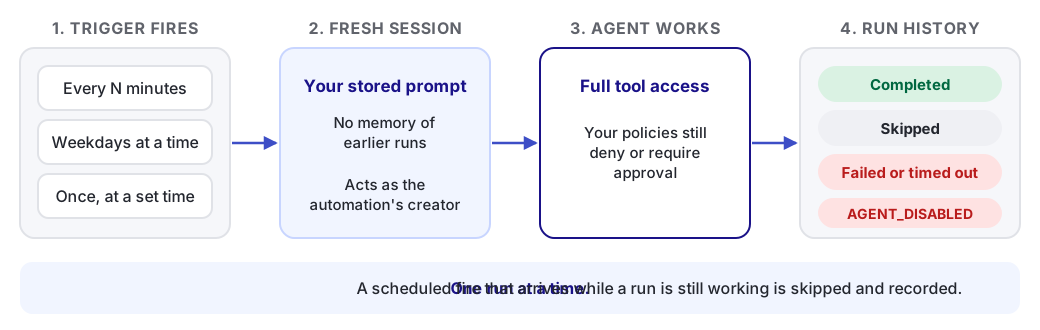
The following diagram shows one run, from the trigger to the run history.
Creating an Automation
-
On Agents, open the agent's ⋮ menu, and click Manage.
-
Click the Automations tab, and click New automation.
-
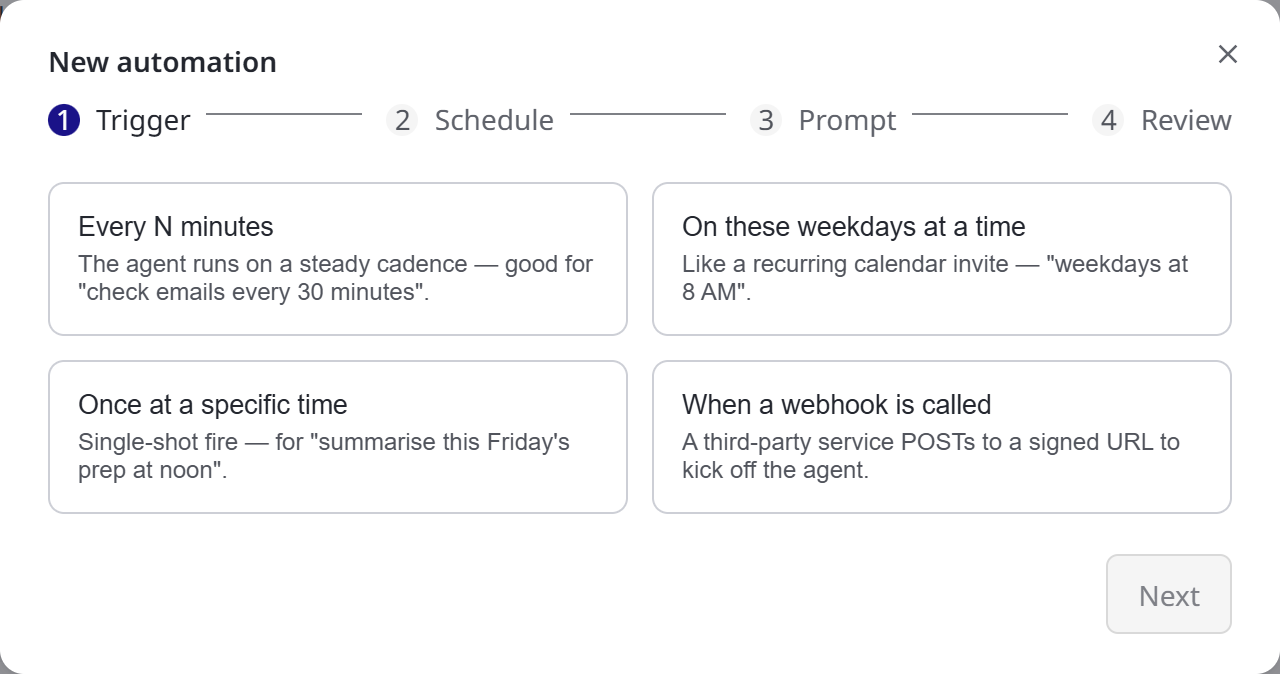
On the Trigger step, pick a trigger, and click Next. See Triggers.
-
On the Schedule step, enter a Name, set the schedule, and click Next. See Schedules.
-
On the Prompt step, write the prompt, and click Next. AgentPass sends it to a fresh session each time the trigger fires. The agent has no memory of previous runs, so write the prompt to stand alone, as you would brief a person on a recurring task.
-
On the Review step, check the summary, and click Create automation.
The automation appears on the Automations tab, active immediately.
Triggers
Pick the trigger that matches how the work arrives.
| Trigger | Good for |
|---|---|
| Every N minutes | A steady cadence, such as checking email every 30 minutes |
| On these weekdays at a time | A recurring slot, like a calendar invite, such as weekdays at 8 a.m. |
| Once at a specific time | A single run, such as summarizing Friday's prep at noon |
Schedules
Each trigger takes its own settings:
- Every N minutes offers Every 5 minutes, Every 15 minutes, Every 30 minutes, Every hour, Every 4 hours and Once a day.
- On these weekdays at a time takes the days, a time and a time zone. AgentPass handles daylight saving changes. The default is weekdays at 08:00 in your own time zone.
- Once at a specific time takes a single future date and time.
How Runs Behave
The automation's run history records every fire. Click History on the automation's row to open Runs — <name>.
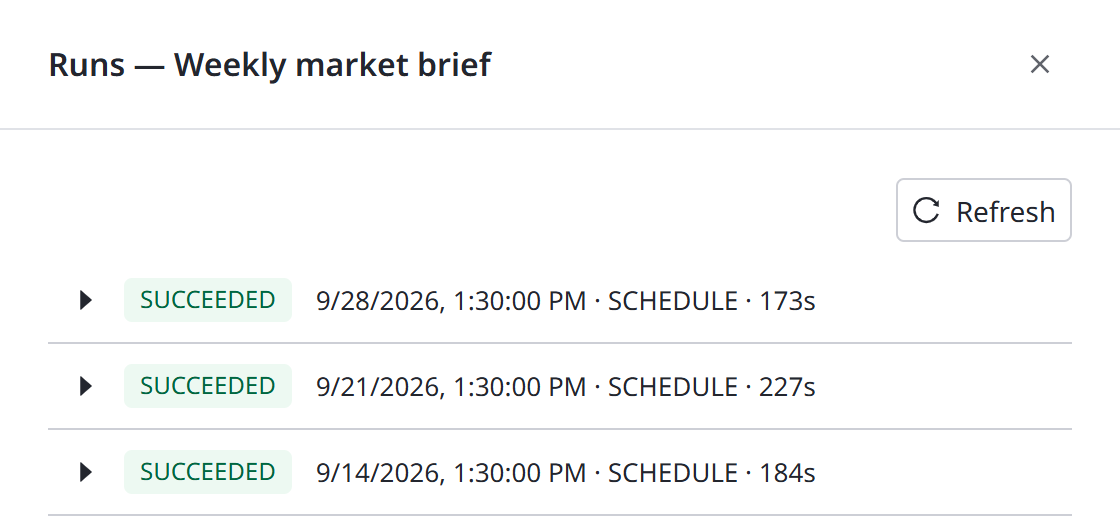
Each run carries one of these statuses.
| Status | Meaning |
|---|---|
| SUCCEEDED | The run completed |
| RUNNING | The run is in progress |
| PENDING | The run has fired and is starting |
| FAILED | The run failed. The reason is shown beneath it |
| OVERLAP_SKIPPED | The previous run was still working, so this fire was skipped |
| AGENT_DISABLED | The agent was off, so the run was skipped or ended |
| TIMED_OUT | The run did not complete in time |
-
One run at a time. A scheduled fire that arrives while the previous run is still working is skipped and recorded. Sessions never pile up. Run now is a deliberate human action, so it bypasses this check.
-
Runs finish on their own. A run completes when the agent's session does. A run that never completes times out, and the timeout is recorded. Failures are recorded on the run and raise notifications, without disturbing the schedule.
-
Runs act as the automation's creator. The creator must be assigned to the agent. The agent runs with that person's tool connections.
-
Agents that are off do not run. A fire against an agent that is off is recorded and skipped.
-
Turning an agent off ends its runs. A run in progress when the agent is turned off ends, with the status AGENT_DISABLED.
To pause or resume an automation, use its switch. The automation keeps its configuration.
To delete an automation that is no longer wanted:
- Open the automation's menu, and click Delete.
- Click Yes, delete automation.
Future fires stop immediately, and the run history is kept.
Everyone assigned to an agent sees all its automations. Only an automation's creator can change, run or delete it, unless your role's Agents: Toggle reaches every agent, as Admin's, Operator's and Security analyst's do. A Supervisor changes only the automations they created.
Example: A Weekday Briefing
This example schedules the Chief of Staff agent.
- On the agent's Automations tab, click New automation, and choose the On these weekdays at a time trigger.
- Name it Weekday briefing, and set Monday to Friday, 08:00, in your time zone.
- Enter the prompt "Summarize my unread mail and today's meetings, and post the briefing to #ops."
- Click Create automation.
- Click Run now to see it work without waiting for tomorrow. The run appears in the history, and the session it started is visible like any other, including its tool calls.
Related
- Cloud Agents: Overview — the agent page, assignments and governance
- Anthropic Cloud Agents — the agents that run automations
- AWS Bedrock AgentCore Agents — scheduling agents that run in your AWS account