Observation Manifest
Overview
The HYPR AgentPass™ observation manifest tells the HYPR endpoint client what to do. It sets which AI tools to watch, how to recognize them, how much activity to report and what to redact before anything leaves the workstation.
You edit your organization's manifest in the Observation manifest editor, on the Agent Observability tab of the Discovered view. Workstations pick up your changes automatically at their next check-in. Adding a tool is a manifest edit, not a client update.
Editing the observation manifest is an administrator task, and requires permission to edit settings.
Until you save your own, your organization inherits the fleet-wide platform default manifest. The tag beside the editor's title shows which you are using: Platform default or Tenant override.
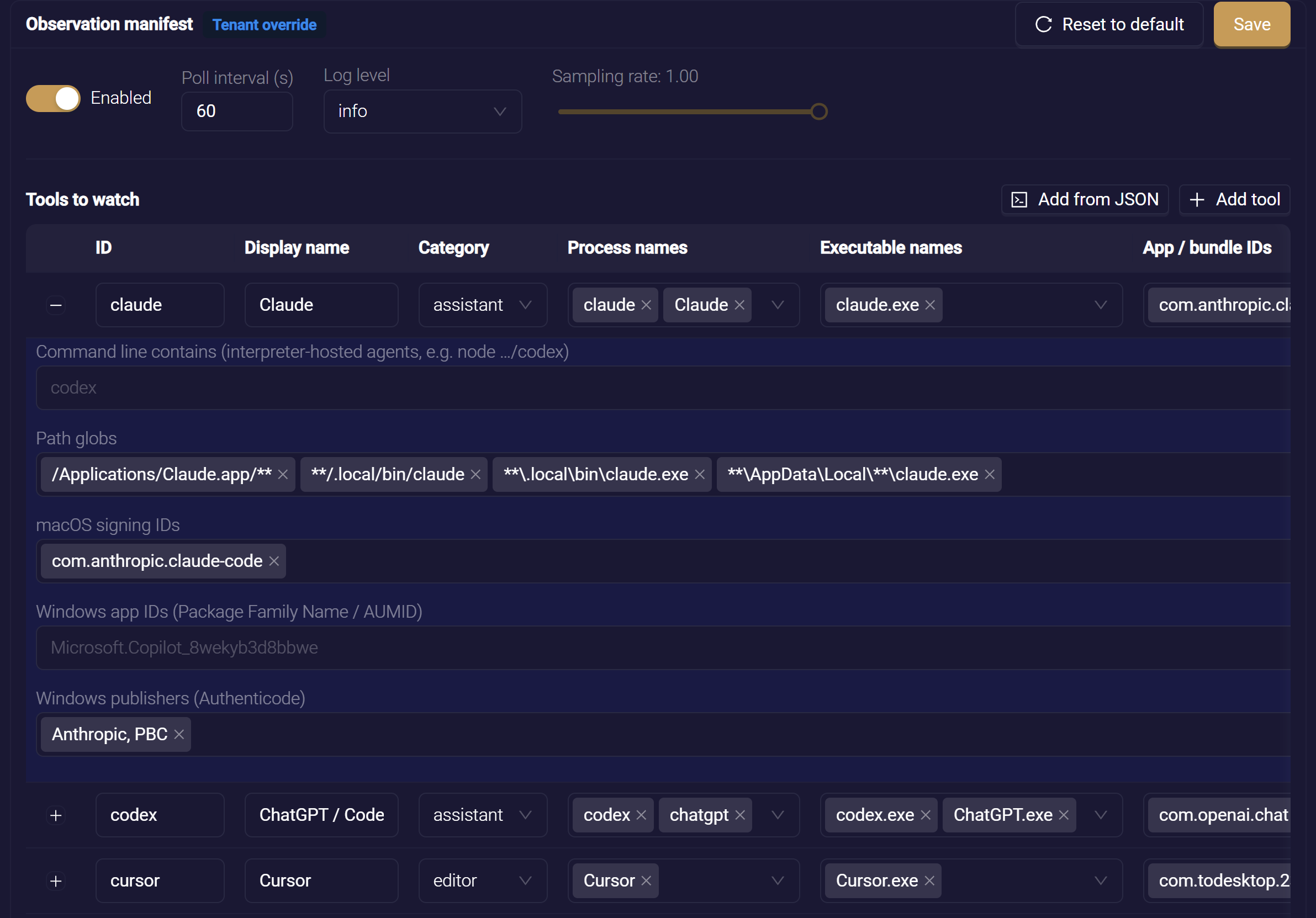
Global Settings
These settings apply to the whole manifest:
- Enabled sets whether workstations observe at all. When it is off, enrolled workstations keep checking in but report nothing.
- Poll interval (s) sets how often workstations check in for the latest manifest, from 10 to 3600 seconds. The default is 60.
- Log level sets how much the endpoint client logs on the workstation:
trace,debug,info,warnorerror. - Sampling rate sets the fraction of matched activity workstations report, from
0.00(none) to1.00(all). Lower it to reduce volume on busy fleets, or raise it toward1.00for complete activity. Sampling is deterministic, so a sampled tool session is reported consistently, not as a scatter of half its events.
Tools to Watch
The Tools to watch table lists the AI tools you want to observe, one per row. Each row has an ID, a display name, a category (assistant, editor, cli, test or other) and a set of matchers. The matchers describe how a workstation recognizes the tool among the programs running on it.
A workstation identifies a tool when any one of its matchers matches, evaluated for the workstation's operating system. One row can therefore describe the same tool across platforms.
The main matchers are in the table itself. Expand a row to reach the rest.
| Matcher | Where | Platform | What it matches |
|---|---|---|---|
| Process names | Table | All | The running process or image name, ignoring case and file extension. claude matches claude, Claude and claude.exe |
| Executable names | Table | All | The exact executable file name, including extension, such as claude.exe |
| App / bundle IDs | Table | macOS, Linux | The reverse-DNS application identifier: a macOS bundle identifier or a Linux application ID, such as com.anthropic.claude |
| Command line contains | Expanded row | All | Text in a tool's command line. Use it to recognize an agent hosted inside an interpreter, such as node running a tool script |
| Path globs | Expanded row | All | A path pattern for the tool's executable, such as /Applications/Claude.app/**. ** spans any number of folders, and * stays within one. Either path separator matches on either platform |
| macOS signing IDs | Expanded row | macOS | The macOS code-signing identifier, such as com.anthropic.claude-code |
| Windows app IDs | Expanded row | Windows | The packaged-app identity for Store and MSIX apps: the Package Family Name or Application User Model ID (AUMID) |
| Windows publishers | Expanded row | Windows | The signed publisher name from the app's Authenticode signature, such as Anthropic, PBC |
Names, paths and command lines match without regard to case. Signing IDs and app or bundle IDs match exactly. When two tools could match the same program, the tool listed first wins, so keep the more specific tool higher in the table.
Some AI tools run inside a general-purpose runtime such as Node.js or Python, so the process name is the runtime, not the tool. Use Command line contains to recognize them, matching the part of the command line that names the tool script.
A match backed by a signature is higher confidence than a match on a name or path, which a look-alike process could imitate. Signatures here are a macOS signing ID, a Windows publisher, or an app or bundle ID. Where you can, include a signature-based matcher, so observed activity is attributed with confidence.
Every tool needs at least one matcher, and a unique ID.
The default manifest already watches Claude Desktop, Claude, ChatGPT and Codex, Cursor, Microsoft Copilot and Gemini, with cross-platform matchers you can adjust or extend.
Add a Tool
To add a tool by hand, click Add tool, and fill in the empty row. To remove a tool, use the remove control at the end of its row.
To add a tool definition you already have in JSON, such as one shared by HYPR or another team:
- Click Add from JSON.
- Paste one tool, a JSON array of tools, or several comma-separated tool objects. Only the
idfield is required. - In the Add tools from JSON dialog, click Import. The editor validates the JSON and adds the tools to the table, where you review and adjust them like any other row.
- Click Save. Importing adds the tools to the editor, and saving publishes them.
A pasted tool whose ID already exists replaces the existing row.
Redaction
Redaction keeps sensitive details out of the activity workstations report. It applies to the command-line arguments and working directory a workstation captures for each tool invocation. It runs on the workstation, before anything is queued or sent.
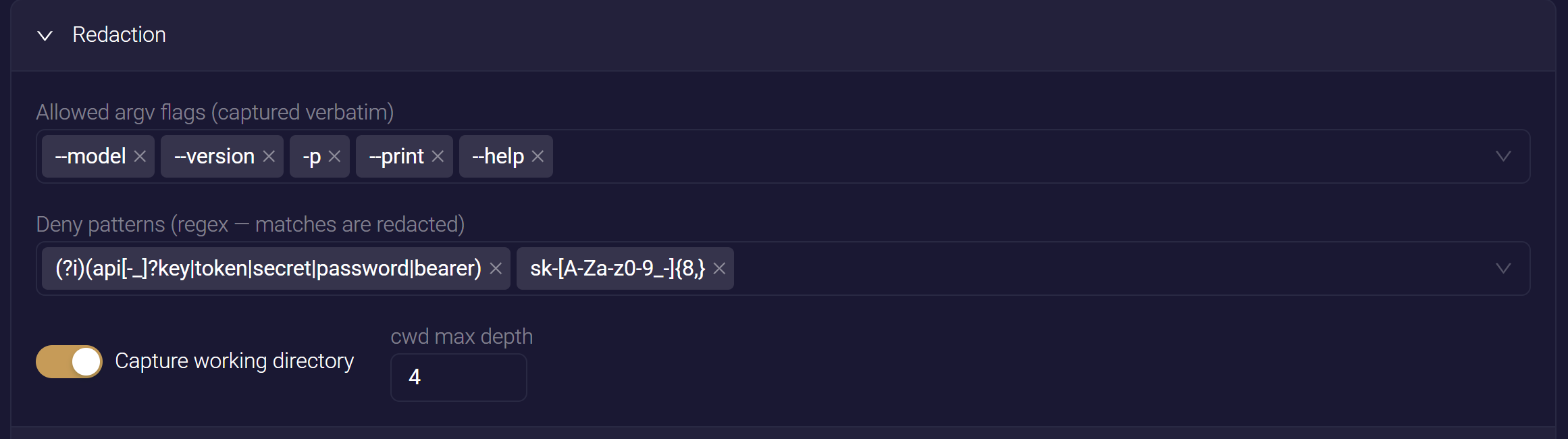
The Redaction panel has these settings:
- Allowed argv flags (captured verbatim) lists command-line flags worth keeping exactly as typed, such as
--modelor--version. An allowed flag is exempt from the deny patterns. The exemption covers the flag itself, not the value that follows it. - Deny patterns (regex — matches are redacted) are regular expressions that mask anything they match. They are a safeguard against secrets slipping through in an argument, such as values that look like API keys, tokens or passwords. Matches are replaced with
***. The editor rejects a pattern that is not a valid regular expression. - Capture working directory sets whether to record the folder the tool was run from. cwd max depth sets how many folder levels to keep. A depth of
4reports/Users/jdoe/project/srcfor a tool run deep inside that tree.
Each argument is handled in turn:
- An argument on the allowed list is kept as is.
- Otherwise, every deny pattern is applied to it, and matches are masked.
- An argument that matches neither list is kept unchanged.
The gateway reapplies your deny patterns to every report it receives, as a backstop. A value that matches a deny pattern is masked before it is stored, even if a workstation missed it.
Save, Preview and Reset
Expand JSON preview to see the complete manifest exactly as workstations receive it. Use it to review a change before you save, or to share a tool definition with another team.
Click Save to publish your changes. Each save produces a new manifest version. A workstation checking in receives the new version, and an unchanged manifest costs it nothing. Devices pick up changes on their next poll.
Reset to default discards your organization's manifest and returns you to the fleet-wide platform default. Use it when you want to stop maintaining your own manifest. Your organization uses the default immediately, and workstations pick it up on their next check-in.
Related
- Enabling Agent Observability — turn on observation and manage enrolled workstations
- Platform Observability — the default manifest your organization inherits
- Endpoint Guard — how workstations apply the manifest and recognize agents